
The Central Hub for DSM Community and Information

For 1990-1999 Mitsubishi Eclipse, Eagle Talon, Plymouth Laser, and Galant VR-4 Owners. This is where the DSM platform history is documented and archived. Log in to help us in our mission, and to remove most ads from the browsing experience.

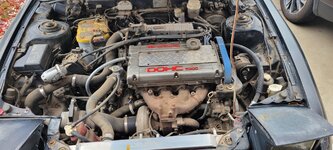
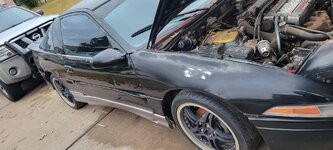
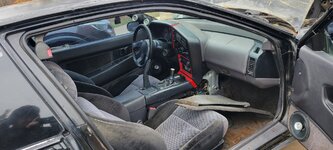
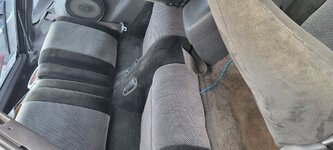
20231029_160050.jpg

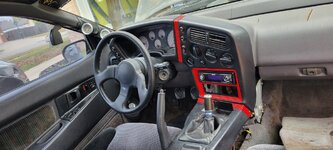
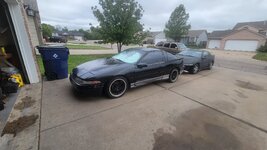
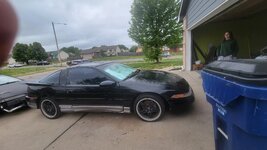
My old highschool car

I regret getting rid of this car but have it back again!!!

This site may earn a commission from merchant affiliate links, including eBay, Amazon, and others.

Yes the shop I’m taking it to is actually a family member of mine. See I was thinking it would take some time also but he’s very reassuring we can knock it out in a day if I come in the morning. Worst comes to worst he said it can sit until we can get everything in but he’s very firm it won’t take long.
That should be ok then, if he is going to help you with it.
 
Yes he said he’s more and willing to help as he already has experience with fuel pump installs, He said the fuel pump will probably take most of the time as the injectors are quick and easy. We are also doing a fuel filter replacement and checking the tank since we are there already. Do you personally think it’s manageable in a day or think it’s going to take longer?
 
Yes he said he’s more and willing to help as he already has experience with fuel pump installs, He said the fuel pump will probably take most of the time as the injectors are quick and easy. We are also doing a fuel filter replacement and checking the tank since we are there already. Do you personally think it’s manageable in a day or think it’s going to take longer?
I also got an update on the fuel pump and it will be here sooner! It’s calling Monday or Tuesday now so I’ll get you those pictures of the part number and top and bottom of pump!
 
I also got an update on the fuel pump and it will be here sooner! It’s calling Monday or Tuesday now so I’ll get you those pictures of the part number and top and bottom of pump!
Good!

Yes he said he’s more and willing to help as he already has experience with fuel pump installs, He said the fuel pump will probably take most of the time as the injectors are quick and easy. We are also doing a fuel filter replacement and checking the tank since we are there already. Do you personally think it’s manageable in a day or think it’s going to take longer?
That sounds pretty good actually. Glad you are doing the injectors too, and the filter, and it's good that he knows to expect rust problems in the tank.
I think it's doable in a day, it just depends on how much trouble you run into.
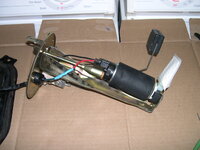
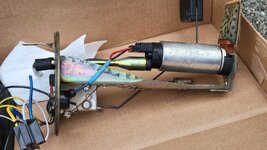
The way the Walbro fits in there looks a little different than how the stock pump fits because the stock pump inlet and outlet pipes are centered on the pump, and the Walbro pipes are on like the edge or periphery of the pump. Also the Walbro pump is physically smaller than the stock pump! That's why the rubber foot that comes with the Walbro install kit is so much thicker than the stock one. It has to be thicker because the Walbro pump is so short.

I suppose you've seen pics in here or somewhere of how the Walbro looks when installed on the fuel pump hanger, but in case not, here's a pic of the one I installed in 2009, except that I took it back out a few weeks later to replace the yellow spacer, o-ring, and cap, with a single piece of viton tubing. Then a pic of the one that English Racing installed in 2016 and I took out in 2022, so in this pic it had been in the tank for 7 years and it was still working fine.
I used the black foam rubber sleeve around the pump body in 2009. ER didn't use it in 2016, or maybe that sleeve isn't sent with the install kits anymore, I don't know.

Either way, you do not strap the pump down with hose clamps or zip ties or any such rubbish. The pump is located by the bellmouth pipe at the top, and by the bottom bracket with rubber foot on the bottom.

Take that bottom bracket seriously. When the fuel pump is making full pressure like when you are at 25 psi of boost, there is about 15 pounds of force pushing the pump down onto that bracket.

As I remember, the screw that holds that bottom bracket in place is a 5mm screw with a Phillips type head for a miserable screw driver! It will probably be pretty rusty. So I sent you some stainless steel 5mm screws with Allen head. A 4mm Allen wrench is what you use on those.

The installs you see that use hose clamps to hold the pump in place are ones where they have cut off the bellmouth part of the pipe and connected the remaining pipe to the pump outlet with submersible hose.

These Walbros are both the style that had black plastic tops. The newer ones have gray plastic tops. Curious to see which type they send you.

DSCN1336  Walbro 255, install in 2009.JPG 20220716_171226  took out the Walbro 255 that ER put in.jpg
 
Last edited:
So just briefly, I sent you the rubber parts to do it like I showed in post #334 but I also sent a single piece of Viton tube that is all cut and chamfered and ready to go right onto a Walbro outlet pipe. I think that the single piece of Viton is really the way you should do it. I think it is the most solid way. If there is some pitting inside the bellmouth from rust, I think this soft viton tube will seal it anyway, because it will seal over a large area, whereas an o-ring only seals along a narrow circular line, and the o-ring is sensitive to how well it is held in position. This Viton is softer (60 Shore A) than most o-rings which are usually 70 Shore A hardness.

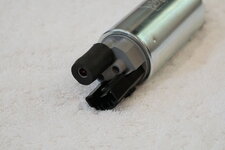
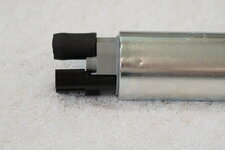
Here's the piece I sent you, shot of it on a new Walbro 255 "gray top" which is the current type Walbro. This piece is about 15/16" long, around 23 to 24mm. It will fit pretty tight into the bellmouth so you need at least motor oil on it, or something like Molykote 111.

There is a small chamfer on one side of it at the bottom edge where it has to fit up against the electrical header on the newer Walbros. I marked that side of it with a silver Sharpie dot, which you can't see in these pics.

DSC01466  Walbro 255 with soft viton tubing over the outlet pipe.JPG DSC01463  Walbro 255 with soft viton tubing over the outlet pipe .JPG
 
So just briefly, I sent you the rubber parts to do it like I showed in post #334 but I also sent a single piece of Viton tube that is all cut and chamfered and ready to go right onto a Walbro outlet pipe. I think that the single piece of Viton is really the way you should do it. I think it is the most solid way. If there is some pitting inside the bellmouth from rust, I think this soft viton tube will seal it anyway, because it will seal over a large area, whereas an o-ring only seals along a narrow circular line, and the o-ring is sensitive to how well it is held in position. This Viton is softer (60 Shore A) than most o-rings which are usually 70 Shore A hardness.

Here's the piece I sent you, shot of it on a new Walbro 255 "gray top" which is the current type Walbro. This piece is about 15/16" long, around 23 to 24mm. It will fit pretty tight into the bellmouth so you need at least motor oil on it, or something like Molykote 111.

There is a small chamfer on one side of it at the bottom edge where it has to fit up against the electrical header on the newer Walbros. I marked that side of it with a silver Sharpie dot, which you can't see in these pics.

View attachment 776742 View attachment 776743
Awesome thank you so much Gary! Everything should be here Tuesday and Wednesday morning and the whole day I will be doing everything so wish a brotha luck!!! The next time you will hear from me will be asking about the injectors update in EcmLink and how everything is changed a good to go Lol!!!
 
The next time you will hear from me will be asking about the injectors update in EcmLink

When you have the 1000cc injectors in the car, make these changes in ECMlink:

On the "Dash" tab, change Knock CEL threshold to 3 degrees retard (instead of 5 degrees)

On the Fuel tab, push the "Calculate" button, put in 900 for the Injector size, and push "Calculate" and then push "Use". That's all in the little Calculator pop-up.
Now you should see -50% in the blank for your Global Fuel number.

I know it sounds wrong for 1000cc but ECM says the PTE 1000's are more like 940cc, and it's better to start out a little richer just for safety. Telling it that the injectors are a little smaller will make it a little richer. We can twiddle that later when we see how it's running.

In Direct Access, let's finish up the timing changes in the lower right part of it (high load and high rpm) which we could have done a while ago but didn't.
That would be the 4 bottom rows, only in the last 5 columns farthest to the right.
The new numbers are just the bold ones in the pic below.
These timing numbers are very low, but we don't know how it's going to go, so it needs to be "safe".

Then when you have Full V3 installed there are a few more things to do:
Turn on MAF Clamp which is in ECU Config on the MAF Clamp tab.
On that tab there is a checkbox that says "Enable MAF clamp function".
Just check that box and then Copy to ECU.

When you start logging with Full V3, turn on Captured Values for ISCPosition and CrankingFuelAdjust.


I'm going to see if I can take a picture that shows where our starter relay is in the car, because that's what we should look at in your car to get started with fixing your Cranking Fuel Adjust. The diagram that I know of in the FSM is pretty bad, but I'll post it along with a photo if I can get a decent one. That will probably be Monday or Tuesday.

For the timing changes:

timing changes for V3 for OhhS.jpg
 
When you have the 1000cc injectors in the car, make these changes in ECMlink:

On the "Dash" tab, change Knock CEL threshold to 3 degrees retard (instead of 5 degrees)

On the Fuel tab, push the "Calculate" button, put in 900 for the Injector size, and push "Calculate" and then push "Use". That's all in the little Calculator pop-up.
Now you should see -50% in the blank for your Global Fuel number.

I know it sounds wrong for 1000cc but ECM says the PTE 1000's are more like 940cc, and it's better to start out a little richer just for safety. Telling it that the injectors are a little smaller will make it a little richer. We can twiddle that later when we see how it's running.

In Direct Access, let's finish up the timing changes in the lower right part of it (high load and high rpm) which we could have done a while ago but didn't.
That would be the 4 bottom rows, only in the last 5 columns farthest to the right.
The new numbers are just the bold ones in the pic below.
These timing numbers are very low, but we don't know how it's going to go, so it needs to be "safe".

Then when you have Full V3 installed there are a few more things to do:
Turn on MAF Clamp which is in ECU Config on the MAF Clamp tab.
On that tab there is a checkbox that says "Enable MAF clamp function".
Just check that box and then Copy to ECU.

When you start logging with Full V3, turn on Captured Values for ISCPosition and CrankingFuelAdjust.


I'm going to see if I can take a picture that shows where our starter relay is in the car, because that's what we should look at in your car to get started with fixing your Cranking Fuel Adjust. The diagram that I know of in the FSM is pretty bad, but I'll post it along with a photo if I can get a decent one. That will probably be Monday or Tuesday.

For the timing changes:

View attachment 776974
Do you want me to go ahead and adjust the timing table or just wait until I do everything Wednesday morning?
 
Do you want me to go ahead and adjust the timing table or just wait until I do everything Wednesday morning?
You can go ahead and adjust the timing table. If you do that before you get your firmware request file from your ECU, then your new firmware will come back to you with it also, so that would save you a few minutes in that you wouldn't have to change the timing numbers again after installing the new firmware.
 
You can go ahead and adjust the timing table. If you do that before you get your firmware request file from your ECU, then your new firmware will come back to you with it also, so that would save you a few minutes in that you wouldn't have to change the timing numbers again after installing the new firmware.
Perfect! I’ll go ahead and do it then, Just to make sure it’s the table to just sent me correct this one?

IMG_2077.png
 
Got it complete and uploaded Gary!

When you look at this chart in V3 Full you'll see that it adds a few more rows off the bottom of this thing, and a few more columns to the right. You won't need the extra columns to the right (over 8000 rpm) but after a while you might need the rows that go off the bottom (beyond Load Factor 2.6). Doesn't need to be done right away.
 
To make CrankingFuelAdjust work, basically there needs to be a wire that connects input 108 of the ECU to what I call the Outbound Leg of the starter button. The outbound leg of the starter button is just the wire that goes from the starter button to the starter solenoid that sits on top of the starter on the engine. The other wire that goes from the starter button just goes (hopefully) to the battery. It's not that one. It's the one that goes to the starter solenoid. So basically the idea is just to send 12 volts to input 108 on the ECU whenever you are pushing the starter button.

I found out that the upper left port of the starter relay socket goes to 108 on the ecu, and that socket is over on the driver side which is handy to my wire that goes to the starter solenoid, so I ran a wire to that port rather than over to the ecu. That looked like this pic at first, but that had a spade that was too wide to go in all the way and it had a too-fat wire, so I changed that later. But this is still the location of it.

20210626_starter relay socket, bad terminal into it.jpg

I didn't get any pics of this today, just could not get into taking down the bottom dashboard panel LOL. It's easy, there are only 4 screws holding it on, but the hood release cable comes down with it so you can't just take it out of the car, and you can't just lay it on the floor either because the cable isn't that long, you have to have like a little cardboard box or something to set it on in the footwell to keep from risking damage to the hood cable.
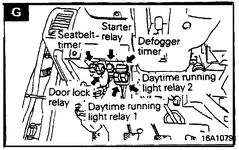
Here's a pic I took out of the FSM that tries to show the location of the starter relay, how you would see it after taking the dashboard panel down, looking forward and up:

Talon starter relay location, from 1990 FSM page 8-14.PNG

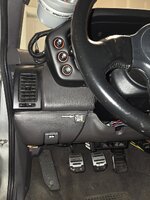
And here is one pic I managed to get today LOL just to make sure you know what dashboard panel I'm talking about - it's the one that has the hood release lever on it. I put a white arrow pointing to one of the screws that hold it on. There's another one at the right end of it, and 2 more underneath. You probably won't find shiny stainless steel like this socket screw is. But they are the same thread of course, which is 6mm x 1.0mm. I'm so tired of fragged up screw head slots, so I sometimes replace them with stainless Allen head socket bolts.

20251013_Talon, showing lower panel that you remove to get at the starter relay, with arrow .jpg
 
To make CrankingFuelAdjust work, basically there needs to be a wire that connects input 108 of the ECU to what I call the Outbound Leg of the starter button. The outbound leg of the starter button is just the wire that goes from the starter button to the starter solenoid that sits on top of the starter on the engine. The other wire that goes from the starter button just goes (hopefully) to the battery. It's not that one. It's the one that goes to the starter solenoid. So basically the idea is just to send 12 volts to input 108 on the ECU whenever you are pushing the starter button.

I found out that the upper left port of the starter relay socket goes to 108 on the ecu, and that socket is over on the driver side which is handy to my wire that goes to the starter solenoid, so I ran a wire to that port rather than over to the ecu. That looked like this pic at first, but that had a spade that was too wide to go in all the way and it had a too-fat wire, so I changed that later. But this is still the location of it.

View attachment 777025

I didn't get any pics of this today, just could not get into taking down the bottom dashboard panel LOL. It's easy, there are only 4 screws holding it on, but the hood release cable comes down with it so you can't just take it out of the car, and you can't just lay it on the floor either because the cable isn't that long, you have to have like a little cardboard box or something to set it on in the footwell to keep from risking damage to the hood cable.
Here's a pic I took out of the FSM that tries to show the location of the starter relay, how you would see it after taking the dashboard panel down, looking forward and up:

View attachment 777026

And here is one pic I managed to get today LOL just to make sure you know what dashboard panel I'm talking about - it's the one that has the hood release lever on it. I put a white arrow pointing to one of the screws that hold it on. There's another one at the right end of it, and 2 more underneath. You probably won't find shiny stainless steel like this socket screw is. But they are the same thread of course, which is 6mm x 1.0mm. I'm so tired of fragged up screw head slots, so I sometimes replace them with stainless Allen head socket bolts.

View attachment 777027
Okay Thank you for those pictures for cross reference! I’ll check it out tomorrow in the morning after I drop the kiddo off at school, Both packages will be here tomorrow also your box and the fuel pump! Is there anything I should do first with the fuel pump to make the install easier when going to pull the original out? I have re read both threads a couple times of the fuel pump installation you have explained and just wanted to double check and clarify is all LOL!
 
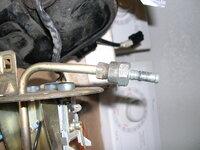
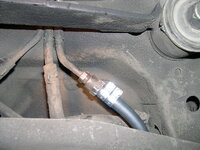
The hardest thing sometimes is just disconnecting the fuel hose. The hose has a steel fitting that attaches it to the pipe that comes out of the tank. You are supposed to be able to disconnect that fitting with 2 wrenches. But that connection was put together very tight at the factory, and then maybe it is seized up a little from corrosion since then. And you don't want to twist that pipe that comes out of the tank. I could never get mine apart. I actually wound up cutting off the rubber hose right near the fitting just so I could then pull the whole pump assembly up and out of there.

I would suggest, maybe your relative at the shop has wrench types that wrap around better to grab more than just 2 flats on those things. If he does, that would help, for getting it apart. I mean, I shot PB Blaster at that thing and it wasn't enough to get it apart.

Maybe somebody has taken yours apart once already in the past, and then it could be easier to take apart now.

As far as cutting the hose like I did, it turned out ok because the rubber hose is so old, 35 years old now, it's not very good anymore, so it was good to replace the hose with new hose anyway. You can't buy a new hose like that from Mitsubishi these days of course.

But it's a project to then replace the rubber hose, and potentially dangerous. The metal fitting on each end of the hose is attached to the hose with steel crimp collars. You have to grind the crimp collars off. For grinding, I used a Dremel tool with little 1 inch abrasive disks. Several of them. If I was doing this now I would use a die grinder with a 3" x 1/16" abrasive cutoff wheel.
The worst part of this project was grinding at the other end of the hose, which is underneath the car, where the hose attaches to the steel pipe that runs all the way up to the fuel filter, because I couldn't get that one apart either.
I'm trying to remember how I did grinding on that end of it without starting a fire.
Ok it didn't start a fire because I was careful to not grind any deeper than just barely through the crimp collar. Not through the rubber hose that's underneath the collar. And then there's another steel part under the hose that you are trying not to ruin anyway because that's the hose barb that you need to put the new hose onto.
I probably also drained the line by first cutting it near the fuel pump and then putting that end of the hose down low so it would drain anything in the line into a pan on the floor, and then get that pan out of there and cover up the cut end of the hose with something.

Building a new hose like this would be a lot easier and safer if you can get the fittings to actually come apart like they are supposed to. Then you can take the hose away from the car and work on it safely far away.
There is a completely different way to replace the rubber hose. It's a kit that replaces, I think, not just the rubber hose, but also the entire steel fuel line that runs under the car, replaces the fuel filter, and goes all the way to the fuel rail. There might also be a kit that replaces just the rubber hose but I'm not seeing it right now.
So this complete kit that I'm looking at right now is the STM -6AN E85 Fuel Tank to Rail Kit for DSM/3000GT.
The Vibrant hose and fittings in this kit are good stuff. The Weldon fuel filter, I've never had one but Weldon stuff is usually the real thing. STM has good pics of all the parts on that web page. As far as I know this is a real good kit.

So that's 2 of the ways you can go if you have to cut the hose to get that thing out of there, or if you just want new stuff there.

Here's 3 pics from my project doing new rubber 5/16" fuel injection hose on the old fittings.
Notice that if you hover over a picture with the mouse, it will show you the file name, and these file names are a pretty good description of what it is. Also will see the file name under the picture if you pick it.

Talon with 5-16ths hose and #13 fuel injection hose clamps replacing stock hose at tank.JPG Talon stock hose barb after you remove the hose.JPG Talon in 2009 with new 5-16ths fuel hose from tank to hard line under car.JPG
 
Last edited:
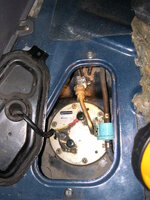
That little blue canister that you see in the 1st picture above is a little fiddly getting it out of the way. Don't wreck it though, it's something you should have in there. As I remember it's a 2-way "jump-over" valve. It's the overfill limiter. I found a note to myself that I decided to grind or cut one or both of the plastic tracks down so they don't hold it in, and then hold it to the vertical metal thing with a zip tie. I think I actually did something like that.

The actual lid is held onto the tank by six little studs that you see. I didn't have any trouble getting the nuts off but if yours are really rusty it could be worse. At least the threads are exposed on those so you can soak them with PB Blaster or WD-40 or any type of penetrating oil before-hand.
 
Gary everything came In here is a picture of the Pump. You said when it comes in to snap some photos so you could make sure.

Good, ok, the pump looks good. The pump is the newest style (is the "gray top" and it has G3 at the end of the GSS number pressed into the barrel). And it's the correct one, the GSS278.

For that pump, the single piece viton I sent is correct for it because it has a small chamfer at the bottom which goes toward the electrical header.

Or, if you were to use the cap + o-ring + spacer method, your spacer would be the 13mm long nitrile hose piece that has a small chamfer at the bottom. That one has 2 silver marks on it from silver Sharpie.

But I think you should use the single piece viton method.

Glad you could get good shots of the numbers on the pump body.

Oops, in the install kit, I don't see the white sock that is like a filter for the pump inlet, and I don't see the little metal lock ring that holds it to the pump. I might see the little metal lock ring. But I don't see the white sock. Is it in there? Gotta have the sock and the lock ring.
 
And just to clarify the Grey Sharpie tube is the little one you’re talking about to use correct? Now it goes over were the red cap is or brown sorry just a bit confused on that part LOL, I’m trying to go back and piece together the install on this from what you have explained but I guess you could say I’m just confused on the correct route to go since you have given a couple to go from. I do agree with Viton method could you elaborate on that a little more so I have a better understanding LOL
 
Add Value - Be Respectful - No Trolling - No Misinformation - Participate Often!
Support Vendors who Support the DSM Community

Build Thread Updates

Latest Classifieds

Back
Top