The Central Hub for DSM Community and Information

For 1990-1999 Mitsubishi Eclipse, Eagle Talon, Plymouth Laser, and Galant VR-4 Owners. This is where the DSM platform history is documented and archived. Log in to help us in our mission, and to remove most ads from the browsing experience.

Crankwalk fix

This site may earn a commission from merchant affiliate links, including eBay, Amazon, and others.

How has the testing gone?

How many times has this fix been used?
What HP levels are the engines using this fix?

In detail, can you explain how this fix solves the crank walk issue?
 
curious to see results in multiple HP level engines. the idea needs to be endorsed by BogusSVO or someone with some authority before it ever takes off

just my .02
 
Personally I've only built two engines with the fix. The second one has been in operation for over a year. My guess is clutch load and driving technique may be as important or more than HP.

Those who do not trust epoxy should not fly in a F22, Boeing 777, nor Drive a McLaren, or Ferrari F50 among many others. The key is how is the bond loaded. I have not strain gaged this design nor performed any Abaqus runs on it. Clearly the bond is being compressed during clutch loading. I would expect minimal shear loading since a torque load could only come from bearing drag which is effectivly a destroyed bearing; if the bearing is destroyed I don't think you care about the epoxy. Bending and peel loading is non-existant here. Oil resistance seems to be a non issue with JB. Overall bond thickness is relatively thin, on the order of 0.020".

Like I wrote in the article, this fix has been used by others who build race engines. When talking with Rick this wasn't a light bulb going off. It seemed to be "oh yeah, just add another thrust washer"

As for the theory, the clutch load (axial thrust bearing load) is delivered over the area of the thrust bearing, resulting in Force/area = pressure. Viscous films are able to support a certain amount of pressure before collapsing, which results in metal/metal contact which inturn creates heat, destroying the bearing surface.

The current design has a "base" area of thrust surface (both bearing halves). By adding another bearing the surface area is increased by more than 50%, effectively reducing the pressure seen by the viscous film. I spoke with a guy who used to test thrust bearings for a living. It is very difficult to maintain or build the viscous layer on a highly loaded thrust bearing, sharp edges tend to scrape the film off, hence the ramps (coining operation) at the ends of the bearing flanges, and our "famed" girdle setting procedure to prevent offset between top and bottom bearings. The expert said coining angle and pressure were the key items to maintain the film layer.

I have written in previous threads about possible differences in natural frequency between 7bolt & 6bolts, the girdle having a much higher axial stiffness, possibly lining up with a crank frequency, possibly pounding the thrust bearing at a specific frequency (a.k.a RPM). This is only speculation.

The only thing the thrust bearing knows is if there is a viscous film layer. Adding thrust surface area gives the film layer less direct pressure trying to collapse it.

You might note our 4G63 thrust bearings have a relatively small area compared with these big wide Thrust Bearing "bannana" Washers.
 
Last edited by a moderator:
What I have done in the past with crank walked evo blocks is, measure the spacing with feeler gauges to determine how much material was eaten from the block. Then I'd add material back by tig welding. Then remove material with sand paper and a file until achieved back an oem spec. I've used this method on about 5 motors none of which showing signs of repeated failure.
 
Going back and reading the full tech artical, and the above explanationM I have a better understanding of the fix.

The logic is there, and it boils down to a simple idea, increase the load area of the thrust area and spread the load out.

The use of roll pins to locate the bearing is not a new idea, that goes back to the 60's maybe earlier than that. I want to say some alum con rods still use this to loate the rod bearings.

I am not keen on the idea of the epoxy, just to much could go wrong, from the applacation of it, it being crused into powder, flaking off, failing do to heat.

I am not saying the epoxy method will not work tho.

Since it is appox .020 thick, I would personally opt for a double stack of .010 shim stock, or a combo of .010, .005, .003 shim stock to set the needed clearance.

Now the issues I do see is

1) lack of direct oil pressure, but that is the same problem on the OE thrust face.

2) Is the condition and surface finish of the now 2nd thrust face on the crank.


The first issue can be a simple issue to deal with, a small groove cut into the main bearing face, about .010 deep and wide, in the proper location would keep a steady stream of oil on the thrust face.

With an orifice that small, I do not see how it would be a noticable drop in pressure or flow to #3 or #5 main.

The other will be a bit more complex to deal with.
Looking at the 7 bolt crank I have, I have a step to deal with.
You must be logged in to view this image or video.


The smooth upper ring is appox .015 above the sprial finished outer ring.
The smooth ring is appox .300 wide.

Now I have to wonder how much contact is being made with the added thrust washer.

Now the inner part could be machined down, but that means machining appox .020 off to get a good prepped flange for the thrust washer to ride agaist, along with having to bring the thrust washer out another .020, now spaced appox .040 from the block.

Looks like I need to hunt up a few local 7 bolts.....
 

Attachments

You must be registered for see attachments list
Last edited by a moderator:
What was mitsu trying to achieve with the revised 2 piece thrush washers design? Does that even reduce the chances of crankwalk?
 
Good pic of the crank flange. The first time I built this I had the flange ridge cut down. The second time I used a stock crank. The surface finish on mine was much better ( I may have polished it, this was a couple years ago). If I remember correctly it fits on the ridge..

I avoided using shims. Right or wrong, I did not like the idea of a stack behind the bearing. I used to formulate epoxies and acrylics for a living, just like anything else, you have to watch the details.

Keep in mind we have an oil film "thickness" which we need to survive the given pressure load. A shim stack could develop multiple films between each shim (each supporting the same pressure load), changing the gap -effectively loading the secondary thrust bearing before the primary. If this were to happen... which film would collapse first? the viscously sheared layer (metal to metal)... or a stagnant layer in the stack?

I'm not a fan of a shim stack.... IMO one should change the thickness of the bearing or build up the block face. (and I ruined a block trying to build the face with brass on my first attempt). This is the reason I punted (2nd time around) on the lower shim mounted to the girdle... too big of gap to close. The bearing used was the thickest bearing I could find with this ID/OD bearing.
 
Last edited:
Good pic of the crank flange. The first time I built this I had the flange ridge cut down. The second time I used a stock crank. The surface finish on mine was much better. If I remember correctly it fits on the ridge.

That is an OE crank from a revised block, factory Thust washer block

Time to look at a few more cranks.
 
how am I so lucky to have a 99 gsx with 185k, beat the piss out of it daily and never "crankwalked"

A fix is NOT a root cause.
Being that we do not have a root cause(s) we have to throw your experience in the big statistical bag and see the distribution has some very successful owners.

Two contributing factors include:
1. many have problems after a rebuild, yours sounds like factory.
2. 99 Models may have different thrust bearings... I'm not sure.
 
how am I so lucky to have a 99 gsx with 185k, beat the piss out of it daily and never "crankwalked"

What clutch is in your car?

A quick theroy of a cause of CW, a heavier clutch. It tries to shove the crank thu the block.

Preventive maintenance can have a hand in it to. Oil breaks down.

I am sure yours is kept up.
 
What clutch is in your car?

A quick theroy of a cause of CW, a heavier clutch. It tries to shove the crank thu the block.

Preventive maintenance can have a hand in it to. Oil breaks down.

I am sure yours is kept up.

ha maybe this is why, im auto
 
I read the article and i gotta say, the day may come(hope not) but i would show that to my machinist or the guys at JAM when i build a 2.3 7 bolt.
Until then, i have a decent understanding of what crankwalk is and the biggest culprit is COLD starts with a heavy PP engaged. The first thing any dsmer, 6 or 7 bolt, should do is wir ethe clutch dummy switch out so you can start in neutral with zero lateral load. Especially us guys with 26,27 even 2900lb PPs. I have NEVER started my car with my 2900lb pp with the clutch depressed, youre just asking for problems. The car wasnt designed originally for that much lateral pressure while cranking with no oil pressure right?

Id like to thank you Bjones for writing up an article like that. Takes balls and seems like you know what youre talking about.
 
....
I can also tell you another thing that will cause one of these motors to walk whether it be a 6 or 7 bolt is running Main bearing clearances looser than Rod bearing clearances....

IMO this statement supports a natural frequency of a crank destroying a film layer. The unsupported crank journals would allow greater crank distortions as it vibrates.
 
Put the main cap on the block and try lining up the thrust surfaces. Some 7 blocks are defective where the thrust surfaces will not line up flush on both side. I discovered this after dissecting a few crank walked 7 bolts engine. If they will not line up, toss the block. Mitsubishi realized something here because they went with the floating thrust bearings in the later year.

Use King main bearings because the thrust bearings have larger thrust surface compared to all the other brand. You can get the set screws and tap from Home Depot to block off the oil squirters so you can increase oil flow to the main bearing.
 
Could you guys weld up the block and machine it down instead of using jbweld?

Like I said in my previous post this is the method Ive used four about 5 years in 5-6 different cars with success. That along with what boost97gst said of disconnecting the clutch switch so the car could be started without depressing the clutch.
 
Could you guys weld up the block and machine it down instead of using jbweld?

The desire for metal is valid. In my original attempt (which failed) I tried brazing (both block & girdle) to bridge the gap. I most likely (heat) tweaked the block since the failure was bearing (not thrust) related (main bearing material infecting a rod bearing which spun). Align honing the crank bore would probably avoided the first failure. R&D on a budget :ohdamn:

The issue becomes $$$. When you heat the block (weld/braze), now you must align-hone your crank bore and possibly re-deck. While this may be a bullet proof approach it certainly increases the cost for the fix, including paying the welder & machine shop. I do not discourage this, however if you can do the same thing for $20, that is also a valid alternative.

Someone might braze or tig a shim on the bearing & then mill the final surface. That may be a "sellable" item. I do not know if all 4G63s would use the same thickness or if different sizes would have to be offered.

On the other hand, if an oil film can survive the pressure load (which is our goal), filled epoxy (JB) with a clean bond to a rough surface is certainly capable of handling the load.
 
Sorry for the thread interuption, but:
The first thing any dsmer, 6 or 7 bolt, should do is wir ethe clutch dummy switch out so you can start in neutral with zero lateral load.
I agree 1000% with this. Regardless of the hows, whys, ifs, etc, etc of crankwalk, nobody could convince me that shoving hard on one end of the crank when everything is cold and dry is somehow a GOOD thing.
 
Last edited by a moderator:
I came across this article but as i was reading it i have a little bit of question that come to mind...

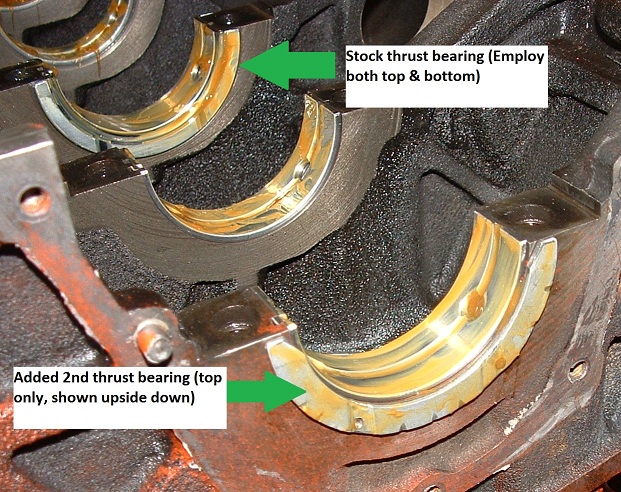
Instead of doing the drilling to add the separate split thrust to the mains on the outside. Why not just use another stock thrust bearings on the outside too? (the stock thrust bearing in the middle that employ both top and bottom). Use another middle main bearing on the out side too.

In this picture you see that the stock main that employ top and bottom in the middle. Would it be possible to add another one of those bearings on the out side too?

http://www.dsmtuners.com/gallery/files/3/2/6/4/0/thrust_assy.jpg

I am not a guru when it comes to building an engine but i just had a thought...
 
Add Value - Be Respectful - No Trolling - No Misinformation - Participate Often!
Support Vendors who Support the DSM Community

Build Thread Updates

Latest Classifieds

Back
Top