IntellectCorner
Probationary Member
- 10
- 3
- May 6, 2023
-
Harrisonburg,
Virginia
[EDIT - As per recommendations, I'm going to move my questions from this original post into their own posts (one for each direct topic/category of thing) and keep them as simple and straightforward as I can. As such, this thread can be just for anyone wanting to get a bigger overview of the situation, more details, or to just say hi or comment / ask questions about my build or any other things on the car. With that in mind, on with my post!]
Hi there everyone! Sorry about this being such a long post and having a bunch of questions in one post, but I didn't want to spam with a bunch of posts, hence one big one. ...although I DID cut out all the performance related questions, and I'll put all that in a different post (in the appropriate forum category), hopefully within the next few days. Anyways, on with this post:
I've got a full interior, stock appearing, but performance wise heavily modified 1991 Eagle Talon Tsi AWD [a full mod list I think is either on my profile or in my post history]. It's been off the road for very roughly 8 years now (although sometimes started and worked on some, and occasionally driven very briefly, during that time). I don't have a garage or any proper place to properly work on my car at home (only a gravel driveway that's on a partial angle), which is a large part of what was holding me back from finishing things (well, that, and money haha). Anyways, we recently trailered the car to by brother's house out of state because he has a great garage to work on it in, plus he's also a very experienced mechanic (even moreso than me). I'm looking to both finish and button up all the things I need to to get it fully, properly fixed, correct, and squared away mechanically (the engine would run while it was sitting, it was the transmission that had issues - that's been fixed a few years ago though), AND pass state inspection [a major PITA]. Thank god no emission inspections in my area at least. Anyways, I'm planning on getting all that done, AND EVERYTHING (or at close to everything as possible) else of all the "would be nice" and "mild annoyance" types of things fixed/given the TLC they needed. i.e. the pop-up headlights were stuck up, windows move very slowly, roof/sun-visor cloth disintegrating, etc.). So lots of work, but mostly smaller / quicker / more straightforward things, but the car should hopefully be REALLY nicely squared away once all that is done. Anyways, most of those things are pretty straightforward, the main things I have questions about are as follows:
I'm looking to get the A/C system working; it's never worked since the day I bought the car, BUT the system DID have like 3 PSI in it (after not having been messed with for nearly 20 years), when we checked a few days ago. So, that's promising - there's clearly some levels of a leak, but it's small enough to still hold a little pressure, and more importantly it means it hasn't been open to the elements. Anyways, I'm looking to replace nearly EVERYTHING in the system, with the potential exceptions being some of the fully-metal hard lines, and the evaporator. So we will be replacing the compressor, condenser, expansion valve, receiver/dryer, etc., the o-rings, and hopefully all the hoses with rubber portions to them.
However, when I look at parts lists, I see two different possible AC compressor types on the car, but nothing specifies how to tell them apart. With the compressor on the car we can't see any writing or stickers on it. I do notice that some say (or show) a v-belt and others a serpentine belt. My car has a serpentine belt on the current compressor (and that matches the crank pulley). At the moment I'm only seeing listings for "models with 10PA17C Compressor" (sometimes also called "nippondenso compressor"), but I definitely remember in the past there being listings for an alternative option.
How can you tell / what is the difference between the two different AC compressors? Is it the difference between V belt and serpentine belt? Or is it more complicated to tell?
Do I have to remove the current compressor to see a sticker or markings on it somewhere...? If I have to than so be it, but if not, it'd save both money (labor) and also means we're leaving even more of the system open for a while (we just a week or two ago had to open the system to get the dash out, because we have to replace the heater core).
...side note to that, the heater cores I see available on parts sites (i.e. rockauto.com) are showing a slightly different design than the original, with one of the metal hoses coming out of the end tank in the center instead of at the end. My brother said he's pretty confident the now models would still fit in the heater core housings, but I'm just curious if anyone had dealt with that vaguely recently (i.e. last several years haha) and knows if the new designs fit OK?
Also, I can only find 2 of the A/C lines (and not even from the same place), I think the two that connect to the compressor itself (high side and low side). Is there anywhere that sells any of the other lines? Ideally I'd like to replace all the lines that have rubber portions in them. I'm almost sure that there's more than those two lines that have rubber portions... I could be wrong though.
I currently only have the factory radiator fan [with it's metal housing]. Therefore there is currently NO condenser fan, and since I'm trying to get the AC working again, I want to add one. Is there any good place to buy a slimline [or equivalent] fan? The only ones I'm finding are stupid expensive... is there any cheaper brand names, or a good place to buy a slimline for a reasonable price?
I ask about a slimline (or similar type) of fan because I'm hoping to put it on the FRONT of the condenser (between it and the FMIC) to keep it away from the turbo heat (and also to leave more space for when I eventually upgrade the turbo even further [currently an Evo 3 16G]).
On a totally different note, the sending unit for my aftermarket oil temperature gauge broke apart. My gauge is an Autometer Oil temp gauge, part number 4347 [I still have the box]. However, I bought that 20+ years ago when I bought the car (as a rolling chassis) and put a motor in it. Based on my research, it appears that the sending unit I need for my gauge is an Autometer 2258 sending unit. ... ... HOWEVER, I discovered that Autometer CURRENTLY uses 4347 as the part number for it's CURRENT, NEW oil temp gauges, and that sending unit part number (2258) is in reference to the CURRENT, NEW gauges. Does anyone know if that's still the part number replacement I need, or has Autometer changed their gauges (and sending units) sometime in the past TWO DECADES... Seems sus that they're using the same part numbers, so I'm VERY hesitant to assume that I'm really comparing apples to apples here. Does anyone know, or have any thoughts on this, or know where I could look up more info to confirm one way or the other?
Moving on, I'm about to install some Brian Crower 276/276 cams while we have the car in the shop. (FYI I very recently learned some basics about installing cams and was made aware of how extremely complicated that can be; just wanted to say that we'll do our research and THOROUGHLY learn how to do it right before we do it. That's a subject for another thread in the future though.) Anyways, this was originally intended to be the only "performance upgrade" work we were doing, with everything else being maintenance, cleaning, or quality of life fixes/things (like the roof lining). However this has snowballed into several other supporting mods/maintenance things related to that... although to be fair, many of those were things that were either a good idea to do now anyways, or was upgrades I was going to have to do eventually anyways.
For example, my stock cam gears were cracked and wobbled a bit (but were like that since I bought the car and ran for like 30 or 40 thousand miles just fine). Still, that's a bit sketchy, and on top of that I've learned that sometimes new aftermarket cams aren't... dialed in correctly...? I may be using the wrong terminology there, but point is I may HAVE to have adjustable cam gears to correct for that and avoid the valves hitting the pistons. Sooo.... I decided to get some adjustable cam gears... but I heard the cheap ones where sketchy at best, and NOT recommended, so I bought a set of AEM cam gears. Both because they're both a good brand name, and because they had FIVE bolts clamping the adjustment in place - and I'm always worried about adjustable cam gears slipping. Of course, with new cam gears that means I should replace the timing belt, even though we just did several years and a few dozen miles ago), so... more cost there. Also, my timing belt slack taker-out-er hydraulic cylinder is ~20 years old (and because I know someone with a race engine that was wiped out with a BRAND NEW one failing), I decided to go with a solid adjuster... slightly more expensive (and more money *sigh* haha), but at least it's a one and done expense. Also, because the cams are my "final upgrade in the chain" to do, it's *possible* I get some MASSSSSSIVE HP gains from it, and my 20+ year old Walboro 255 pump might not be up to the task. So I bought a MAJORLY upgraded in-tank pump. Specifically this one:
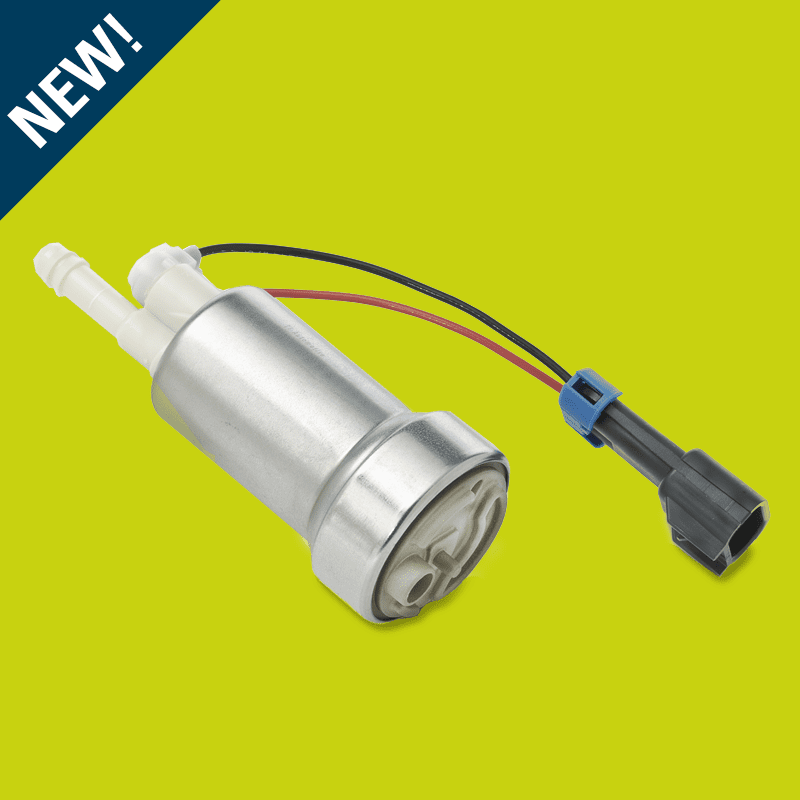
 www.extremepsi.com
I'm getting that specific here because even though it was listed as for my car, unless we're missing something obvious, we're like 98% sure it DOES NOT fit in the factory fuel pump housing.
www.extremepsi.com
I'm getting that specific here because even though it was listed as for my car, unless we're missing something obvious, we're like 98% sure it DOES NOT fit in the factory fuel pump housing.
Anyways, I'm not upset about that, I just need to figure out a way to get it to work. I know some people cut the factory supply line [metal line] that the stock pump mounts into, and then run a hose from the top of the pump to that. But I really, REALLY do NOT want to cut up (in that way) my pump housing, in case something goes wrong and I have to go back to a literally-stock-style pump like the Walboro 255.
What's the possibility of finding a used stock fuel pump housing? I'm assuming nearly zero, and/or it's going to cost a liver and a kidney to get it. Since I have an AWD 1g, I believe the pump housing is different from ALL the rest of the 1g options (which were FWD - both the turbo and non-turbo). AND I'm 1g, not 2g - meaning even older old car parts haha. Anyways, is anyone familiar with mounting options for pumps like this? I'm wondering about the possibility of maybe turning the pump like 20-30 degrees or so to get the output port of the pump to NOT line up with the stock supply line, and then running a rubber hose from that off to the side a little and find a spot to drill a hole in the bulkhead and mount some fittings there (so you can connect the rubber hose to the fitting on the bottom of the bulkhead, and a new hose (probably AN line) on the top. FYI I still have the factory fuel lines. Anyways, thoughts? Any alternative suggestions, or does that sound like a good idea? And how likely am I to find another fuel housing? [because of how rare they are they're probably genuinely WORTH a bunch of money, but I wouldn't be willing to spend very much. If I can go through the bulkhead in a different spot, I can retain the original supply line just in case. If I can find a good solution (i.e. possibly what I just mentioned), then I don't need another fuel pump housing (even if that did turn out to be a practical and affordable option). I'm hoping and assuming we'll be able to figure something out with my current housing, but that's why I'm asking here, to get thoughts and ideas and options.
...side note to that, doing that would require the pump being held in with zip ties and/or clamps. Would that hold it in place well enough over, say, 100,000 miles of bumps and speedbumps and hard pulls and the usual bumping and movement of use? I'm assuming probably others have tried this method (although maybe not that many miles on it), what has your luck been?
While we're talking about fuel pump housings, on the 1g AWD models such as mine, the fuel level sending unit is an integral part of the fuel pump housing. While my fuel gauge worked for the majority of the time I owned the car while it was still driving, the gauge worked; but for the last while I was driving it (maybe a year or two) the gauge didn't work (I can't remember details, I want to say it just always stayed at 3/4th tank or something like that). I'm not sure if the issue is the sending unit or the gauge in the instrument cluster, but the sending unit seems vastly more likely. Thankfully I do have a spare instrument cluster, but unfortunately we forget to try that before we pulled the dash apart (the current state of the car), so I wasn't able to try that yet.
Anyways, the question is, is there any easy way to test the fuel level sending unit? i.e. is there a certain wire you can read with a multimeter, or is it more complicated than a voltage range or something like that?
ALSO, there appears to be only one wire connected to the sending unit - is this correct, or is a wire missing or disconnected? There is a wire running into the tank from the bulkhead that's taped off with electrical tape, which is.... odd (seems VERY unlikely the factory would have done that), but I most definitely didn't - so even if the wire was attached to the level sending unit and broke, it wouldn't have had electrical tape put on it.... soooo... yea.... mystery there. Any thoughts? Is there any diagrams of what all the wires that go through the bulkhead are supposed to be for? (Yes, the low fuel light sensor is ALSO running though this bulkhead, but as far as I know that's still working, it was working when the fuel level sending unit wasn't, so as far as I know it's not something I need to mess with, hence why I only mentioned it now).
Moving on, all that brings us to another question: Assuming I can eventually figure out how to mount that fuel pump, then I've just MASSIVELY upgraded my pump, to something with almost TWICE the flow capability of my old pump (DANG these new technology pumps are SOOOOO cool!). I'm running FULLY stock fuel lines from the pump, to the rail, using a stock rail (upgraded injectors of course though), a stock FP regulator, and stock return lines. Do I need to upgrade my Fuel Pressure Regulator now that I've just doubled my fuel flow? (which might be close to quadruple the stock amount) Side question, I'm using a stock regulator, which is ~35 years old now; do those go bad over time? i.e. is it a good idea to replace it now, even if I didn't have to? (that said, I know I'd probably eventually need to upgrade the FPR in the future if I get a bigger turbo and make big power).
Assuming I do need to get a new, upgraded FPR (looks like they're around $160 to $280 or so). However, that brings up two questions:
1.) What pressure should I set it to?
and 2.) How do I know what it's set to.
I'm assuming the answer to "2" is that I need a fuel pressure gauge. BUT, unless I'm remembering wrong, I don't think there's anywhere to tap in a fuel pressure gauge from the factory. Do aftermarket fuel pressure regulators have an access port to mount a gauge from?
Side question to that, I'm also curious in what ways the factory FPR regulates the pressure. I know it has a vacuum line that runs to it; does it do anything under vacuum, or is this just to chance (raise, I would assume) the fuel pressure based on boost, to compensate for the boost pressure working against the fuel pressure? Assuming that's the case, is the factory regulator just a 1:1 ratio in how much it raises it?
Also, approximately how much fuel pressure is the factory pressure (at idle / before it's raised by boost)? (this would allow me to figure out how high the fuel pressure could get at max, and what my pump could flow at that pressure). For reference, I could conceivably be able to spike to 30 PSI boost, although most likely my engine [with all it's mods] flows too well for it to spike that high, so probably more likely 25-28 PSI).
Another side question to all that, if I get an aftermarket FPR, is it a good idea to slightly raise the base fuel pressure to get better fuel atomization, or does that cause it to reach fuel pressures at max boost that a harsh on the injectors? [forcing the injector ball open too violently]
Lastly, I'm looking to replace the speedometer cable (the speedometer gauge in the instrument cluster "bounces" a couple of MPH up and down while driving at any speed, which is really annoying - I'm hoping replacing this cable will fix that). Rockauto.com lists two different options, a 45.5 inch long cable and a 44.0 inch long one. My brother measured the one in my car and it's around 43.0 inch (go figure). He said the 44.0 inch one looked probably the closest, and that the end points appeared to be the same as the one on the car [as best as you can tell from a photo]; does this sound correct? Also, is replacing the cable likely to fix this issue?
Thanks in advance for any help / answers / advice you all can give me!!! I realize this is a large numbers of questions, so it's totally fine if you only have answers or comments on one or two of them, please still chime in if that's the case!
I'm so, So, SO, SOOOOO super excited about getting my car on the road and getting to drive it again! I don't think I've seen a single 1g DSM (of ANY type/submodel) on the road in my area in over a decade, and maybe just 2 or 3 2g cars in over a decade (there is 1 2g non-turbo regular driving around though). Anyways, it's really sad I don't see more, but on the plus side, I think my car is going to get a very, VERY lot of attention in the area, because they're SO rare now (particularly ones that are AWD Turbo, in good condition, AND running / driving / passes inspection). Heck, over the last 8 years when it's been sitting, even the few times I do drive it to get gas or take it to a shop, literally almost every time I stop somewhere (i.e. gas station) even with how briefly I'm there, someone says something about the car. And that's been mostly a couple to several years ago, they're even more rare now. I was just at a big car show yesterday and chatting with some people, one person there was like " thank you SOOOO much for keeping that car preserved and on the road" haha. There was a LOT of people I talked to that know and love the DSMs and said they were really excited to see the car in the future once I finish getting it on the road. Sadly no turbo DSMs there, just the 1 local with the non-turbo 2g. I hope to change that with my car in the future haha.
FYI I also have several more performance related questions, what certain things can handle, upgrade options, etc. and things like that, but this post is already crazy long (plus those are different subjects) so I'm going to make a separate post about that stuff shortly, hopefully within a few days (possibly much sooner). I'll also post an as-detailed-as-I-can full mod list of my car, which can also be used for future reference.
I'll also eventually have some questions about some other things, like painting the car, but at this point there's too many other questions and mechanical things that I need to get done first haha, so I'll ask about that stuff once I get closer to that point. I would love to paint it before I take it home, but no idea if that'll be at all practical / an option, we'll see.
Hi there everyone! Sorry about this being such a long post and having a bunch of questions in one post, but I didn't want to spam with a bunch of posts, hence one big one. ...although I DID cut out all the performance related questions, and I'll put all that in a different post (in the appropriate forum category), hopefully within the next few days. Anyways, on with this post:
I've got a full interior, stock appearing, but performance wise heavily modified 1991 Eagle Talon Tsi AWD [a full mod list I think is either on my profile or in my post history]. It's been off the road for very roughly 8 years now (although sometimes started and worked on some, and occasionally driven very briefly, during that time). I don't have a garage or any proper place to properly work on my car at home (only a gravel driveway that's on a partial angle), which is a large part of what was holding me back from finishing things (well, that, and money haha). Anyways, we recently trailered the car to by brother's house out of state because he has a great garage to work on it in, plus he's also a very experienced mechanic (even moreso than me). I'm looking to both finish and button up all the things I need to to get it fully, properly fixed, correct, and squared away mechanically (the engine would run while it was sitting, it was the transmission that had issues - that's been fixed a few years ago though), AND pass state inspection [a major PITA]. Thank god no emission inspections in my area at least. Anyways, I'm planning on getting all that done, AND EVERYTHING (or at close to everything as possible) else of all the "would be nice" and "mild annoyance" types of things fixed/given the TLC they needed. i.e. the pop-up headlights were stuck up, windows move very slowly, roof/sun-visor cloth disintegrating, etc.). So lots of work, but mostly smaller / quicker / more straightforward things, but the car should hopefully be REALLY nicely squared away once all that is done. Anyways, most of those things are pretty straightforward, the main things I have questions about are as follows:
I'm looking to get the A/C system working; it's never worked since the day I bought the car, BUT the system DID have like 3 PSI in it (after not having been messed with for nearly 20 years), when we checked a few days ago. So, that's promising - there's clearly some levels of a leak, but it's small enough to still hold a little pressure, and more importantly it means it hasn't been open to the elements. Anyways, I'm looking to replace nearly EVERYTHING in the system, with the potential exceptions being some of the fully-metal hard lines, and the evaporator. So we will be replacing the compressor, condenser, expansion valve, receiver/dryer, etc., the o-rings, and hopefully all the hoses with rubber portions to them.
However, when I look at parts lists, I see two different possible AC compressor types on the car, but nothing specifies how to tell them apart. With the compressor on the car we can't see any writing or stickers on it. I do notice that some say (or show) a v-belt and others a serpentine belt. My car has a serpentine belt on the current compressor (and that matches the crank pulley). At the moment I'm only seeing listings for "models with 10PA17C Compressor" (sometimes also called "nippondenso compressor"), but I definitely remember in the past there being listings for an alternative option.
How can you tell / what is the difference between the two different AC compressors? Is it the difference between V belt and serpentine belt? Or is it more complicated to tell?
Do I have to remove the current compressor to see a sticker or markings on it somewhere...? If I have to than so be it, but if not, it'd save both money (labor) and also means we're leaving even more of the system open for a while (we just a week or two ago had to open the system to get the dash out, because we have to replace the heater core).
...side note to that, the heater cores I see available on parts sites (i.e. rockauto.com) are showing a slightly different design than the original, with one of the metal hoses coming out of the end tank in the center instead of at the end. My brother said he's pretty confident the now models would still fit in the heater core housings, but I'm just curious if anyone had dealt with that vaguely recently (i.e. last several years haha) and knows if the new designs fit OK?
Also, I can only find 2 of the A/C lines (and not even from the same place), I think the two that connect to the compressor itself (high side and low side). Is there anywhere that sells any of the other lines? Ideally I'd like to replace all the lines that have rubber portions in them. I'm almost sure that there's more than those two lines that have rubber portions... I could be wrong though.
I currently only have the factory radiator fan [with it's metal housing]. Therefore there is currently NO condenser fan, and since I'm trying to get the AC working again, I want to add one. Is there any good place to buy a slimline [or equivalent] fan? The only ones I'm finding are stupid expensive... is there any cheaper brand names, or a good place to buy a slimline for a reasonable price?
I ask about a slimline (or similar type) of fan because I'm hoping to put it on the FRONT of the condenser (between it and the FMIC) to keep it away from the turbo heat (and also to leave more space for when I eventually upgrade the turbo even further [currently an Evo 3 16G]).
On a totally different note, the sending unit for my aftermarket oil temperature gauge broke apart. My gauge is an Autometer Oil temp gauge, part number 4347 [I still have the box]. However, I bought that 20+ years ago when I bought the car (as a rolling chassis) and put a motor in it. Based on my research, it appears that the sending unit I need for my gauge is an Autometer 2258 sending unit. ... ... HOWEVER, I discovered that Autometer CURRENTLY uses 4347 as the part number for it's CURRENT, NEW oil temp gauges, and that sending unit part number (2258) is in reference to the CURRENT, NEW gauges. Does anyone know if that's still the part number replacement I need, or has Autometer changed their gauges (and sending units) sometime in the past TWO DECADES... Seems sus that they're using the same part numbers, so I'm VERY hesitant to assume that I'm really comparing apples to apples here. Does anyone know, or have any thoughts on this, or know where I could look up more info to confirm one way or the other?
Moving on, I'm about to install some Brian Crower 276/276 cams while we have the car in the shop. (FYI I very recently learned some basics about installing cams and was made aware of how extremely complicated that can be; just wanted to say that we'll do our research and THOROUGHLY learn how to do it right before we do it. That's a subject for another thread in the future though.) Anyways, this was originally intended to be the only "performance upgrade" work we were doing, with everything else being maintenance, cleaning, or quality of life fixes/things (like the roof lining). However this has snowballed into several other supporting mods/maintenance things related to that... although to be fair, many of those were things that were either a good idea to do now anyways, or was upgrades I was going to have to do eventually anyways.
For example, my stock cam gears were cracked and wobbled a bit (but were like that since I bought the car and ran for like 30 or 40 thousand miles just fine). Still, that's a bit sketchy, and on top of that I've learned that sometimes new aftermarket cams aren't... dialed in correctly...? I may be using the wrong terminology there, but point is I may HAVE to have adjustable cam gears to correct for that and avoid the valves hitting the pistons. Sooo.... I decided to get some adjustable cam gears... but I heard the cheap ones where sketchy at best, and NOT recommended, so I bought a set of AEM cam gears. Both because they're both a good brand name, and because they had FIVE bolts clamping the adjustment in place - and I'm always worried about adjustable cam gears slipping. Of course, with new cam gears that means I should replace the timing belt, even though we just did several years and a few dozen miles ago), so... more cost there. Also, my timing belt slack taker-out-er hydraulic cylinder is ~20 years old (and because I know someone with a race engine that was wiped out with a BRAND NEW one failing), I decided to go with a solid adjuster... slightly more expensive (and more money *sigh* haha), but at least it's a one and done expense. Also, because the cams are my "final upgrade in the chain" to do, it's *possible* I get some MASSSSSSIVE HP gains from it, and my 20+ year old Walboro 255 pump might not be up to the task. So I bought a MAJORLY upgraded in-tank pump. Specifically this one:
Walbro / TI Automotive 525 LPH Hellcat High Performance In-Tank Fuel Pump *SALE* & Selected
F90000285 HELLCAT 525LPH FUEL PUMP HAS THE HIGHEST OUTPUT IN-TANK FUEL PUMP ON THE MARKETTI Automotive F90000285 39/50 Fuel PumpEnjoy the highest output on today’s market with our new DCSS 39/50 fuel pump. Able to support an aggressive 700+ horsepower, with a super charger, this innovative dual...
www.extremepsi.comAnyways, I'm not upset about that, I just need to figure out a way to get it to work. I know some people cut the factory supply line [metal line] that the stock pump mounts into, and then run a hose from the top of the pump to that. But I really, REALLY do NOT want to cut up (in that way) my pump housing, in case something goes wrong and I have to go back to a literally-stock-style pump like the Walboro 255.
What's the possibility of finding a used stock fuel pump housing? I'm assuming nearly zero, and/or it's going to cost a liver and a kidney to get it. Since I have an AWD 1g, I believe the pump housing is different from ALL the rest of the 1g options (which were FWD - both the turbo and non-turbo). AND I'm 1g, not 2g - meaning even older old car parts haha. Anyways, is anyone familiar with mounting options for pumps like this? I'm wondering about the possibility of maybe turning the pump like 20-30 degrees or so to get the output port of the pump to NOT line up with the stock supply line, and then running a rubber hose from that off to the side a little and find a spot to drill a hole in the bulkhead and mount some fittings there (so you can connect the rubber hose to the fitting on the bottom of the bulkhead, and a new hose (probably AN line) on the top. FYI I still have the factory fuel lines. Anyways, thoughts? Any alternative suggestions, or does that sound like a good idea? And how likely am I to find another fuel housing? [because of how rare they are they're probably genuinely WORTH a bunch of money, but I wouldn't be willing to spend very much. If I can go through the bulkhead in a different spot, I can retain the original supply line just in case. If I can find a good solution (i.e. possibly what I just mentioned), then I don't need another fuel pump housing (even if that did turn out to be a practical and affordable option). I'm hoping and assuming we'll be able to figure something out with my current housing, but that's why I'm asking here, to get thoughts and ideas and options.
...side note to that, doing that would require the pump being held in with zip ties and/or clamps. Would that hold it in place well enough over, say, 100,000 miles of bumps and speedbumps and hard pulls and the usual bumping and movement of use? I'm assuming probably others have tried this method (although maybe not that many miles on it), what has your luck been?
While we're talking about fuel pump housings, on the 1g AWD models such as mine, the fuel level sending unit is an integral part of the fuel pump housing. While my fuel gauge worked for the majority of the time I owned the car while it was still driving, the gauge worked; but for the last while I was driving it (maybe a year or two) the gauge didn't work (I can't remember details, I want to say it just always stayed at 3/4th tank or something like that). I'm not sure if the issue is the sending unit or the gauge in the instrument cluster, but the sending unit seems vastly more likely. Thankfully I do have a spare instrument cluster, but unfortunately we forget to try that before we pulled the dash apart (the current state of the car), so I wasn't able to try that yet.
Anyways, the question is, is there any easy way to test the fuel level sending unit? i.e. is there a certain wire you can read with a multimeter, or is it more complicated than a voltage range or something like that?
ALSO, there appears to be only one wire connected to the sending unit - is this correct, or is a wire missing or disconnected? There is a wire running into the tank from the bulkhead that's taped off with electrical tape, which is.... odd (seems VERY unlikely the factory would have done that), but I most definitely didn't - so even if the wire was attached to the level sending unit and broke, it wouldn't have had electrical tape put on it.... soooo... yea.... mystery there. Any thoughts? Is there any diagrams of what all the wires that go through the bulkhead are supposed to be for? (Yes, the low fuel light sensor is ALSO running though this bulkhead, but as far as I know that's still working, it was working when the fuel level sending unit wasn't, so as far as I know it's not something I need to mess with, hence why I only mentioned it now).
Moving on, all that brings us to another question: Assuming I can eventually figure out how to mount that fuel pump, then I've just MASSIVELY upgraded my pump, to something with almost TWICE the flow capability of my old pump (DANG these new technology pumps are SOOOOO cool!). I'm running FULLY stock fuel lines from the pump, to the rail, using a stock rail (upgraded injectors of course though), a stock FP regulator, and stock return lines. Do I need to upgrade my Fuel Pressure Regulator now that I've just doubled my fuel flow? (which might be close to quadruple the stock amount) Side question, I'm using a stock regulator, which is ~35 years old now; do those go bad over time? i.e. is it a good idea to replace it now, even if I didn't have to? (that said, I know I'd probably eventually need to upgrade the FPR in the future if I get a bigger turbo and make big power).
Assuming I do need to get a new, upgraded FPR (looks like they're around $160 to $280 or so). However, that brings up two questions:
1.) What pressure should I set it to?
and 2.) How do I know what it's set to.
I'm assuming the answer to "2" is that I need a fuel pressure gauge. BUT, unless I'm remembering wrong, I don't think there's anywhere to tap in a fuel pressure gauge from the factory. Do aftermarket fuel pressure regulators have an access port to mount a gauge from?
Side question to that, I'm also curious in what ways the factory FPR regulates the pressure. I know it has a vacuum line that runs to it; does it do anything under vacuum, or is this just to chance (raise, I would assume) the fuel pressure based on boost, to compensate for the boost pressure working against the fuel pressure? Assuming that's the case, is the factory regulator just a 1:1 ratio in how much it raises it?
Also, approximately how much fuel pressure is the factory pressure (at idle / before it's raised by boost)? (this would allow me to figure out how high the fuel pressure could get at max, and what my pump could flow at that pressure). For reference, I could conceivably be able to spike to 30 PSI boost, although most likely my engine [with all it's mods] flows too well for it to spike that high, so probably more likely 25-28 PSI).
Another side question to all that, if I get an aftermarket FPR, is it a good idea to slightly raise the base fuel pressure to get better fuel atomization, or does that cause it to reach fuel pressures at max boost that a harsh on the injectors? [forcing the injector ball open too violently]
Lastly, I'm looking to replace the speedometer cable (the speedometer gauge in the instrument cluster "bounces" a couple of MPH up and down while driving at any speed, which is really annoying - I'm hoping replacing this cable will fix that). Rockauto.com lists two different options, a 45.5 inch long cable and a 44.0 inch long one. My brother measured the one in my car and it's around 43.0 inch (go figure). He said the 44.0 inch one looked probably the closest, and that the end points appeared to be the same as the one on the car [as best as you can tell from a photo]; does this sound correct? Also, is replacing the cable likely to fix this issue?
Thanks in advance for any help / answers / advice you all can give me!!! I realize this is a large numbers of questions, so it's totally fine if you only have answers or comments on one or two of them, please still chime in if that's the case!
I'm so, So, SO, SOOOOO super excited about getting my car on the road and getting to drive it again! I don't think I've seen a single 1g DSM (of ANY type/submodel) on the road in my area in over a decade, and maybe just 2 or 3 2g cars in over a decade (there is 1 2g non-turbo regular driving around though). Anyways, it's really sad I don't see more, but on the plus side, I think my car is going to get a very, VERY lot of attention in the area, because they're SO rare now (particularly ones that are AWD Turbo, in good condition, AND running / driving / passes inspection). Heck, over the last 8 years when it's been sitting, even the few times I do drive it to get gas or take it to a shop, literally almost every time I stop somewhere (i.e. gas station) even with how briefly I'm there, someone says something about the car. And that's been mostly a couple to several years ago, they're even more rare now. I was just at a big car show yesterday and chatting with some people, one person there was like "
thank you SOOOO much for keeping that car preserved and on the road" haha. There was a LOT of people I talked to that know and love the DSMs and said they were really excited to see the car in the future once I finish getting it on the road. Sadly no turbo DSMs there, just the 1 local with the non-turbo 2g. I hope to change that with my car in the future haha.FYI I also have several more performance related questions, what certain things can handle, upgrade options, etc. and things like that, but this post is already crazy long (plus those are different subjects) so I'm going to make a separate post about that stuff shortly, hopefully within a few days (possibly much sooner). I'll also post an as-detailed-as-I-can full mod list of my car, which can also be used for future reference.
I'll also eventually have some questions about some other things, like painting the car, but at this point there's too many other questions and mechanical things that I need to get done first haha, so I'll ask about that stuff once I get closer to that point. I would love to paint it before I take it home, but no idea if that'll be at all practical / an option, we'll see.
Last edited:


 As for budget, we're slightly over what I was optomistically hoping for, but still well within what I knew was a strong likelyhood and was willing to spend. Assuming we don't run into too many other things, or at least not any majorly expensive things, I'll probably be at around $1200 to $1500 in parts, everything combined, for this entire maintenace trip, so probably $2000 to $2500 for EVERYTHING including labor, that's REALLY not bad for just how much work we're doing on the car, INCLUDING installing upgraded cams, lifters, cam gears, and a massively upgraded fuel pump haha. It helps that I parted out another DSM many years ago and have a bunch of spare parts from that, such as another set of headlight assemblies and motors, etc., and COUNTLESS other misc things, bolts, brackets, etc. And if the total goes up a little bit that's OK, particularly if it means I'm getting other upgrades for that additional cost - although we're trying to not do any excessive upgrades now, as I do want to get it back on the road and get some miles on it and see how it does, to make sure there isn't any major issues we're unaware of (i.e. if, god forbid, we had to rebuild the engine for some reason, etc.). Not that that would be cateclysmic, assuming it was just a rebuild and not a catestrophic failure type of problem, but would still really such haha.