The Central Hub for DSM Community and Information

For 1990-1999 Mitsubishi Eclipse, Eagle Talon, Plymouth Laser, and Galant VR-4 Owners. This is where the DSM platform history is documented and archived. Log in to help us in our mission, and to remove most ads from the browsing experience.

Are there Clutch Pedal Rebuild kits?

This site may earn a commission from merchant affiliate links, including eBay, Amazon, and others.

rdeis

10+ Year Contributor
71
23
Feb 28, 2013
Falcon, Colorado
Hey, all, my clutch linkage has given up.

I've seen references to a Whitespeed rebuild kit and a Forced Performance rebuild kid for the clutch pedal assembly, but I can't find any for sale.
Do these things still exist? Where can I find one?
 
I'm sure there are other writeups, but take a look here: https://www.dsmtuners.com/threads/how-to-1g-clutch-pedal-welding-bushing.156805/
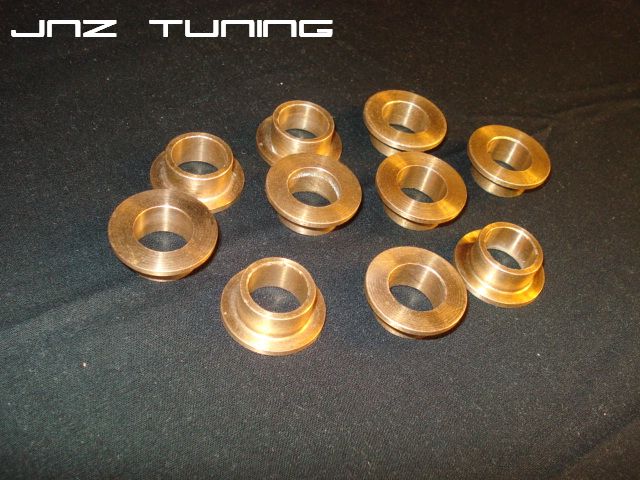
You can find brass bushings from ExtremePSI or STMTuned. This is not a rebuild kit, but replacement for the plastic bushing that will melt when you weld it.
I plan to do this to mine someday...but not looking forward to the pedal removal so I might just pull the whole dash cuz I need to replace the heater core too.
 
Thanks!

On the welding.. Has anyone tried using a pin and slot for this instead of welding or fixing the square? This thing really looks like a keyway kind of problem to me, but I haven't studied it nearly as closely as many others.
 
Extreme psi sells a bushing that replaces the plastic one that wears out. But that has no bearing on the hole being worn out.

 
Thanks!

On the welding.. Has anyone tried using a pin and slot for this instead of welding or fixing the square? This thing really looks like a keyway kind of problem to me, but I haven't studied it nearly as closely as many others.
I've heard every answer possible on that over the last 25+ years when it comes to fixing and welding it.

How someone didn't come out with a very overbuilt replacement solution to the whole thing is beyond me. @FIBA M - EC17PSE this is like tailor-made for you.
 
I've heard every answer possible on that over the last 25+ years when it comes to fixing and welding it.

How someone didn't come out with a very overbuilt replacement solution to the whole thing is beyond me. @FIBA M - EC17PSE this is like tailor-made for you.
I have no idea on this as have only seen pictures, but not something that was from what I can tell a terrible thing from the normal way.

I would have to read up on it and see what the deal is.

What is the main concern on the normal fixing of it? Not having people weld it or more of make something abolt on fix that is stronger and robust?
 
 
What is the main concern on the normal fixing of it? Not having people weld it or more of make something abolt on fix that is stronger and robust?
Some thoughts:
1> I saw several complaints about a weld not holding. Getting a good quality weld is tricky for this kind of joint.
2> of course welds prevent you from taking things apart later.
3> Welding can damage bushings in this assembly that you'd have to un-weld to replace (swapping plastic for bronze before welding is the normal suggestion)

After I get mine out and apart I'll take some pictures and show you what I'm thinking for durable and strong non-weld solution. It'll take some fine craftsmanship to be slop-free.
 
For me it was the D-shaped hole in the stamped steel arm getting wiped out once I put a heavier clutch in the car.
(Ok, its been a few years, it might not be D-shaped, but the flat keyed surface was getting wiped out)

There was rotational slop between the shaft the clutch pedal is welded to, and this arm.

You'd push in the clutch and a couple inches of your foot travel was used up as this slop in the D-shaped keyed hole was taken up.

I never saw the shaft actually wiped out in several 1g's, it was always that stamped steel arm that bolted on the end.
 
Last edited:
I think the biggest issue is the difficulty level of removing the pedal assy. Nobody wants to experiment with a "bolt on" fix when historically, welding has proven to be sufficient. The weld joint is only as strong as the fabricator makes it, but does require special equipment a lot of hobbyists don't have. Which is where the OP comes in I would guess.

Short of replacing bushings, I don't think there would be a reason to separate the clutch pedal from the pedal assy. That's my best guess why a rebuild kit doesn't exist today.
 
I had always suspected the shaft is harder for whatever reason. As stated above the ones ive seen its always the "D" shaped hole that's the pronlem.
Somebody should try to make a better lever with a hardened hole. Welding was just simple and basically free.
 
The weld joint is only as strong as the fabricator makes it, .... Which is where the OP comes in I would guess.
Pretty much. Special skills, too. I've had welds break on other projects because the welder isn't a pro. Researching the forums I've seen a lot of complaints about the weld breaking when using this fix, prolly also because the fabricator or his tools aren't up to the task.

I've got an idea for a fix that only requires a drill press, file, and some craftsmanship.

So problem is basically this. The angles between the rod and the arm are much better for digging out hole than they are for transmitting a shear load, so that's what happens.
If the shaft is harder than the arm like you suspect, that would make the "digging-out" problem even worse.

You must be logged in to view this image or video.


I propose a solution that uses a shear pin. This puts the load at right angles to the surface, so it can’t dig out the hole.

If the slot is cut carefully, the only way you develop play in this joint is by cutting the pin:

You must be logged in to view this image or video.


If I were a machinist with proper tools, I think I’d rather cut a key way in the round edge of the shaft instead of a hole and pin through the flat sides, but the principle is the same. Make the joint mechanical and transmit the shear load at right angles to the surface.
 

Attachments

You must be registered for see attachments list
Last edited:
Swapped in a spare pedal set that seems tight, it had half the miles as the old one. Brand new OEM master as well. Waiting for the battery to recharge before starting and testing.

That job makes for a long discouraging day. I don't know how you guys get these things out! I had to take the clutch linkage end apart to get the pedal assembly out of the car. Which was odd-- the nut on the end of the shaft didn't feel nearly as tight as I expected......

After getting the old pedal set out of the car and putting it back together, the play seems gone? I'd hate to think that the reason I had play in the linkage was as simple as the nut on the end of the shaft working loose and allowing the linkage arm to slip!

Dunno. Either way I have nice new bushings and arms and things.
 
Swapped in a spare pedal set that seems tight, it had half the miles as the old one. Brand new OEM master as well. Waiting for the battery to recharge before starting and testing.

That job makes for a long discouraging day. I don't know how you guys get these things out! I had to take the clutch linkage end apart to get the pedal assembly out of the car. Which was odd-- the nut on the end of the shaft didn't feel nearly as tight as I expected......

After getting the old pedal set out of the car and putting it back together, the play seems gone? I'd hate to think that the reason I had play in the linkage was as simple as the nut on the end of the shaft working loose and allowing the linkage arm to slip!

Dunno. Either way I have nice new bushings and arms and things.
Reassemble the old assembly on the bench. Even with the nut tight a worn assembly will have movement. It will be obvious.
 
Kk, I’ll do that.

Meanwhile, everything new is in, and I’ve still got the same measured 15mm at the exposed end of the clutch fork and no disengagement. ):
 
Kk, I’ll do that.

Meanwhile, everything new is in, and I’ve still got the same measured 15mm at the exposed end of the clutch fork and no disengagement. ):
Start over. What happened? You may have two problems and one just played on the other.
 
Either you still have air in the hydraulics or something is amiss inside the bell housing (fw step, throwout bearing, fork, pivot ball, or clutch falling apart). Do you ever notice a rattle sound coming from the clutch?
 
Meanwhile, everything new is in, and I’ve still got the same measured 15mm at the exposed end of the clutch fork and no disengagement

If your 15mm is the amount of slave rod travel you are getting, well, that's 0.590 inches, and that's between 9/16" and 5/8" which is what I had on my car (that's an interesting thread BTW) when I had a heavy single disc clutch (ACT 2700) on the car. It was enough to get clutch disengagement at normal civilian rpm levels like up to 7000 rpm or so. I don't know anything about your clutch but I'm surprised that 15mm doesn't disengage it, even at all, like at idle? So probably there is something wrong inside the bellhousing. It's a worthy effort trying to get rid of the slop that is in the stuff outside the bellhousing, but even if you get rid of that type of slop, there is still flex in some of those parts. Deflection due to heavy loading. (Different kind of slop). So when you go measure everything and figure out the lever ratios and the hydraulic ratios and so forth, it just doesn't add up very well to what you get at the slave when there is a heavy load against it.

The only actual "Mod" I've ever had on my pedal assembly parts is a nut welded to the front face of the clevis like you see in post #4 here.
That gives me a couple more turns available on the master rod, which in my case was enough to take up the slop. But it doesn't change the deflection issues at all. That was done at the same time that the ACT 2700 was put in the car, because there wasn't enough disengage without that mod.
Note that this mod does not preload the master cylinder. I still had the piston in the master cylinder coming all the way back to where it has a hard stop at the rear end of the cylinder. All it did was enable me to get the "Pedal Free Play" all the way to 0 (pedal free play at the top of the pedal stroke, foot off the pedal) so that my entire 29 degrees of pedal stroke was doing something.
 
Last edited:
> The only actual "Mod" I've ever had on my pedal assembly parts is a nut welded to the front face of the clevis like you see in post #4 here.

I've had good success with that same mod. I measured 15mm of travel on another well-running Talon Sunday, so that fits with what your car does and I'm forced to agree something is amiss in the bellhousing. I've been resisting that because every once in a while I can get the clutch to disengage, but its never been consistent and I never figured out why.

To start over as @pauleyman requested--
Car:
1994 Talon AWD.
Southbend clutch (I did run an ACT2100 for many years, but that's not on it now. I never ran a 2600+)
2.4L
16G, 19psi pump gas and a very incomplete tune.
Welded nut to the master cylinder clevis for the extra turn of adjustment.
2- part carrier bearing supports
Drivetrain is otherwise stock, with well over 200k miles. I have swapped the tranny a couple of times, but have no reason to suspect problems with the transmission.

Problem:
As I was coming to a stop at a light on the way to work, I pushed the clutch pedal in and something went wrong. It felt like something mechanical broke, or slid, or stretched in the linkage. The pedal did not go to the floor, it still sprang back more or less correctly, but with much less force than normal.

When the light turned green, the car would not go in to any gear. I pumped the pedal several times, no change. Broken and stranded in traffic.

The long sad story of diagnosis:
After getting to the side of the road, I popped the hood and found the clutch master reservoir empty. Added fluid, no change. No obvious big leaks either. Clutch fork leve moved, though didn't have anything to measure it with.

Towed it home and looked more closely. Found fluid and grease around the pushrod to the master cylinder under the dash, so I went over to FLAPs and got a new master (free under warranty). As I removed the old master, the welded nut broke free from the clevis. I concluded that the "break/bend" I felt was related to this.

I modified the clevis on the new master cylinder with a nut extension in a different way, reinstalled the master, bled the system with my pressure bleeder, clutch disengaged, tranny shifted, and all seemed well.

Pulled the bleed system off, put away all the tools, went to test drive and the car wouldn't go in gear. What gives? Ok, got the pressure bleeder back out, re-bled the system, found a couple really tiny bubbles, tested, all seemed well. Put the tools away and it stopped working again.

This sent me on a week long journey of relearning everything I thought I already knew about the clutch hydraulics. Found a few small leaks in the system in the system and fixed them. Over that week, the pedal feel got stiffer and softer and sometimes disengaged properly and sometimes didn't. I never got consistent correct behavior, and I never figured out why, so I kept chasing hydraulic problems.

In the end, I was convinced that the system was properly bled, tight and right. (With the pressure bleeder that's actually very easy to do if you're not second guessing yourself. Awesome tool!) After that I measured 15mm of movement at the fork.

Car still won't go in to gear.

So I did a careful inspection under the dash and found 25mm of play between the pedal and the master cylinder piston rod.

Replaced the pedal with a near-new stock assembly. No measurable play in the pedal now. Same 15mm of movement on the fork, car still won't go in to gear.

AFAICT, looking inside the bell housing is all that's left?
 
Last edited:
Sounds to me like you had a clutch disk dampener spring come loose or some other foreign object get lodged underneath the pressure plate fingers. I've had that happen no less than 3 times in my DSM. Same symptom too - just stopped working mid cruse/stop and go traffic. I've also had the MC go dry, and that is a completely different symptom where the clutch falls the the floor and/or requires pumping.
That's why I asked if you ever hear a rattle from the clutch. I guess not?
 
Sounds to me like you had a clutch disk dampener spring come loose or some other foreign object get lodged underneath the pressure plate fingers. I've had that happen no less than 3 times in my DSM. Same symptom too - just stopped working mid cruse/stop and go traffic. I've also had the MC go dry, and that is a completely different symptom where the clutch falls the the floor and/or requires pumping.
That's why I asked if you ever hear a rattle from the clutch. I guess not?
I haven't heard any rattles, no.
 
Sounds to me like you had a clutch disk dampener spring come loose or some other foreign object get lodged underneath the pressure plate fingers
Give that man a cigar!

Took me a while to set aside a Saturday to tear in to it. When I did that's precisely what I found. I never heard a rattle or anything to indicate debris inside the bell housing, so it must have jammed up immediately when it broke out from it's proper place.

Been a while since I did this swap-- What's the favorite 400hp clutch these days?
 
Sounds to me like you had a clutch disk dampener spring come loose or some other foreign object get lodged underneath the pressure plate fingers. I've had that happen no less than 3 times in my DSM. Same symptom too - just stopped working mid cruse/stop and go traffic. I've also had the MC go dry, and that is a completely different symptom where the clutch falls the the floor and/or requires pumping.
That's why I asked if you ever hear a rattle from the clutch. I guess not?
Yup. Happened to me, no warning.
 
Add Value - Be Respectful - No Trolling - No Misinformation - Participate Often!
Support Vendors who Support the DSM Community

Latest Classifieds

Back
Top