The Central Hub for DSM Community and Information

For 1990-1999 Mitsubishi Eclipse, Eagle Talon, Plymouth Laser, and Galant VR-4 Owners. This is where the DSM platform history is documented and archived. Log in to help us in our mission, and to remove most ads from the browsing experience.

IMG_2267.jpeg

Street Build Red5.

Build

This site may earn a commission from merchant affiliate links, including eBay, Amazon, and others.

My exhaust separated itself from the turbo🙃

Had to reverse ⏪ back into drive way, shortest drive ever.
I removed the exhaust and took it to a shop, that had previously failed me with exhaust welding on another car.

I should have known better, the welder was complaining it was hot 🥵? And that this would require a whole new J-pipe and that he can’t weld a bong?!?

Men have only become a shadow, of what they once were, so rather than deal with drama 🎭 queens, I decided to buy my own machine
IMG_0765.jpeg

This 4-1 machine was only 90$ and can flux,mig,stick and tig. I played around with the flux and stick for a few mins and decided to just do it. Zero previous experience, but the machine is simple so I only adjusted the amps, had to stay low to not burn 🔥 through.
IMG_0646.jpeg

IMG_0763.jpeg
IMG_0764.jpeg

Just need to weld one………………….. ☝️ more
hanger directly above.
 
Last edited:
Decided to go back to the civic dual core half radiator I used earlier in the thread.
IMG_0799.jpeg

I had to because my slim fan failed and I decided I wanted another SPAL shrouded fan. And it only fits with a half rad.
IMG_0811.jpeg

IMG_0810.jpeg

I now have both the curves and straight versions of the 13” shrouded series.

The straight paddle is a lill shorter, so it fits better in front of the exhaust manifold.
IMG_0787.jpeg
IMG_0788.jpeg
IMG_0789.jpeg


The curves one (1860) cfm pulls around 13 amps
And the straight one (1680) cfm pulls around 10 amps well within the 30 amps allowed by the fuse box 📦.

I went ahead and replaced the dryer, since some threads 🧵 on here also mentioned that being a cause for excessive coolant temps when AC is on.

Once I refilled the system.
IMG_0818.jpeg

IMG_0819.jpeg

I was able to get 55 F at the vents with very low rpm and the car never overheated or went past 195-200 with the AC running for about 30mns.

55 is good considering it was 95 F today and I have a massive intercooler in the way.

Haven’t had AC in this car in some time
It’s also so much hotter in FL this summer!
 
Last edited:
Decided to go back to the civic dual core half radiator I used earlier in the thread.
View attachment 770840
I had to because my slim fan failed and I decided I wanted another SPAL shrouded fan. And it only fits with a half rad.
View attachment 770838
View attachment 770839
I now have both the curves and straight versions of the 13” shrouded series.

The straight paddle is a lill shorter, so it fits better in front of the exhaust manifold.
View attachment 770841View attachment 770844View attachment 770845

The curves one (1860) cfm pulls around 13 amps
And the straight one (1680) cfm pulls around 10 amps well within the 30 amps allowed by the fuse box 📦.

I went ahead and replaced the dryer, since some threads 🧵 on here also mentioned that being a cause for excessive coolant temps when AC is on.

Once I refilled the system.View attachment 770846
View attachment 770847
I was able to get 55 F at the vents with very low rpm and the car never overheated or went past 195-200 with the AC running for about 30mns.

55 is good considering it was 95 F today and I have a massive intercooler in the way.

Haven’t had AC in this car in some time
It’s also so much hotter in FL this summer!


Street car baby! Another DSM with working A/C in the Florida summer? Winning!

Best mod I’ve done on my dsm.
 
Well it turns out the bushings were being held in by memories of better times
Because I didn’t need any tools they just came out ………😬
IMG_1185.jpeg

I’m planning on using these OEM bushings from a lancer they are what I would call 90% exact for our cars but it looks to be a little wider, so I may have to shave down the ends a little.
IMG_1186.jpeg

IMG_1187.jpeg


This is the listing title
Rear Differencial Assembly Bushing For Mitsubishi Lancer 2009-2017 OEQuality 4WD


IMG_1188.jpeg


With the help of the community I was able to conclude these are the closest thing to an OEM bushing I could find for the GSX


Thanks 🙏 again @jdxnc

the alternatives are solid--- No thanks.
 
Last edited:
I manage to spend a whole day hammering 🔨 with chisels
And I got one of the old inserts out

And I was able to push in the new one
It needs a little vibration to get in, but that means I can also wiggle back out

IMG_1189.jpeg


So these bushings are a hair smaller ; which is great because I can just do some tack weld to fully secure it.

This is great because now I can replace the other diff mount (in front )

And now I can add the missing fourth mounting point on the diff.
Since this item comes in 2.
IMG_1190.jpeg

The other one just started to come out on its own when i used the saw saw
This one was much faster

But since there’s no scoring inside the walls of this mount frame bore ( from absence of hammering )

This side; slides in and out, without any resistance, will probably need very thin shims to press it in before welding.
 
Last edited:
Do you cut out the trunk so you don't have to drop the subframe? Or how does this process work?
Yes 👍
The main point is I don’t want to drop the sub frame - and my frame mount bushings are solid, so no need to change those.

But there’s other reasons, most of us have some rust in the trunk in the 2g.

This gives me the option to repair it and re- install the trunk. I planned on using latches for quick disconnect if I go this route.

Or I can make a custom trunk for my meth 🌬️ Spare tire 🛞 or something else.

Getting older means I wanna do a lot less work.
👴
 
Well I almost had a massive failure 😨
Almost cross threaded the rear differential case, a shim ( metal wire ) got in the way.
But I was able to recover from this.

I concluded these bushings are about 0.2mm of wall thickness to thin, so I used metal wire to create some resistance for the bushings, so I can hammer them into place it seems to work well.
IMG_1191.jpeg

I will also place 2 tack welds on each bushing for better support

The proper solution would be a very very thin wall collar to place bewteen the bushing and frame but we’ll see how well this method performs
IMG_1193.jpeg

The lancer bushings are cut flushed on one side only, this is the exact length of the oem bushings - it makes contact against the case and sits flush against frame in the front, on the other side.


The rear differential is now SOLID no movement at all like before

I still need to do the third bushing in the front and add the 4th mount

But so far it’s great 😊
I’m happy to report there’s a real alternative to solid bushings !!!!!!!
 
Last edited:
You have a link or part number for them bushings?
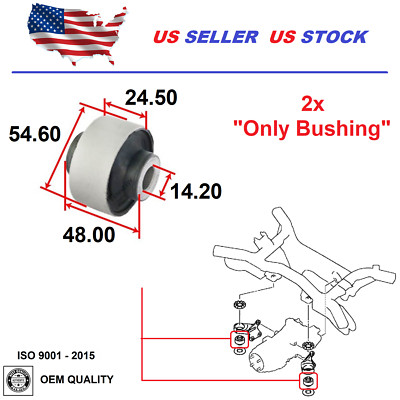
So I provided the item description in BOLD
So anyone can look it up; because there’s several options: there’s the OEM style and the after market style


This is the listing I used it has the best price for the OEM ones and I settled on these because they actually have the dimensions provided; which made this experiment work out!

I ordered another set for the front mount of the rear diff.

For anyone’s future reference once link is dead these are for the Mitsubishi lancer / outlander / Jeep patriot / compass all for the same years (2009-2017).
 
Last edited:
Thank you, I just ordered a set. I have the old Split Racing poly mounts but people have had issues with them separating in the past. Hopefully it doesn't happen to mine but I'll keep these around just in case. I also don't care to have solid mounts on mine.
 
Important update

The 2nd set of bushings arrived in less than 36hrs from order !

I went to my local machine shop to try out different shim thickness since I figured they would have a wide selection
IMG_1197.jpeg

The 0.4mm looks like it could work but I felt like it would be to difficult to use
The 0.2mm still requires a small press and goes it easier

After some test fitting I have concluded the shim you want to use is a 0.2mm sheet.

The shop allowed me to cut what I needed
But you can find these shims on EBay as well.


IMG_1202.jpeg
IMG_1203.jpeg

Notice we press the bushing until flushed with top bore.

IMG_1201.jpeg

And we only cut the marked lip on one end of the bushing the side mating with the frame. Otherwise the new bushing will stick out past the bore (this will center it )

And I was able to reinstall without removing frame
IMG_1204.jpeg
IMG_1205.jpeg


Last thing : the bushing are advertised as 54.6mm but this is not true if it were there would be no need for shims

They measure more like 54.2mm this
Is why we need those 0.2mm shims to make up the difference

Now you know if you decide to do this
 
Last edited:
In today’s episode of “let’s use parts ment for other cars”
IMG_1275.jpeg

M6x1.00 ball joints
IMG_1276.jpeg
IMG_1278.jpeg


IMG_1273.jpeg
IMG_1274.jpeg

At max lift - no contact on hood ends, closes without restriction.

Requires very limited modification just some light hammering on black brackets.

I can now access engine bay without support bar in the way and less chance of bumping into the corners.
 
Decided to make good use of MATLAB while I still have academic access to it, so I wrote a code to help me both visualize and smooth the power band/3rd gear pull on my VE table from my last recorded dyno pull, that I never applied any post processing to in the past.
1767848321108.png

I apply a moving avg to the band, I made this a vector based on the observed points in " track data log" in the detached window, on the VE table.

1767848354426.png

this example is a light amount of smoothing to the NEW VE TABLE - the red is the " tracked path/pull" of the old VE table before any smoothing
1767848381667.png

1767849402052.png

Here more weight is used and therefore the surface is much smoother, this looks nice, but too much smoothing can lead to a lean AFR, in my case I intentionally tuned on the rich side, so I see some benefit to this. I also plan on doing this for the timing as well, to also try and be more efficient.

Trying to be more road worthy.
 
Last edited:
Excellent use of MATLAB, by the way what are you studying to be using such a program?
Thanks, I recently finished my masters in Aerospace Engineering- my focus is “GNC”
Guidance Navigation and Controls.
——— Rocket 🚀 science 🧪 ———

So I still have access using my school credentials- for now. I have been using Matlab for a very long time, since my bachelors, it’s a great math processing tool.

I use it to sometimes visualize the work I do in C/Arduino .
 
Well you've got me beat, I am trying to get my B.Ed in Secondary Math. Although, since you are familiar with C and Arduino I might pick your brain on some code once I get it written (this is for the solid state switching controller).
 
Expanded the program to include and smooth the timing table.
1769396214966.png

No smoothing yet just plotting the current table
I also converted, scaled and plotted the provided spec-table for a generic EBAY 4-Bar MAP Sensor and compared it to the actual measured values captured thru ECMLink. To truly know how true the sensor is. The reason for this test is to ensure the sensor works were its most important, and that's while in boost.

1769396256082.png


How I performed the test :
IMG_1314.jpeg

IMG_1315.jpeg


I noticed unlike the OMNI that read -0.2InHg at Atmosphere (ATM) this EBAY sensor reads +1.8Psi at rest.


The plot shows the error being about |3.1|InHg while at idle, (I idle at -10InHg due to 272's) this error becomes smaller with voltage/pressure. At rest ENGINE OFF the error is smaller to around 1.8Psi, at around 10Psi the error reduces to 1.2Psi and at 20Psi the error is 0.8Psi and at 30Psi (my max) the error is only 0.2-0.7Psi. I continued to plot the sensor up until 5.00v and surprisingly the sensor remains very accurate even at the top range. Honestly, I'm very impressed with this sensor-both in performance and price.
1769397838948.png

The Solid lines are the compressor gauge pressures and dotted are the MAP sensor pressures.
Basically the RED line is the 4-Bar measured sensor linear function captured in ECMLink and the BLUE is the provided spec-table. They are nearly exact with only a small error in the Vac region ~ the safest part to have an error.

Ok so what is even the point........... rather than pay 150 + for a MAP that will go out. I can build a redundant system for a fraction of the price, that interpolates or trust one sensor more than the other should I lose a MAP sensor while driving/Boost this way I won't have to pull over and be broken down or possibly blow an engine, the controller will automatically switch to the more accurate sensor.
The first step in doing this is to map out a function we can trust as a TRUE path, that part is done with the above.

This would of course require also capturing and plotting another separate sensor, perhaps the AEM boost gauge and or RPM to truly create a decent system that uses multiple parameters to keep the system intelligent. Open to any suggestions on this.


* Note this TEST was done with the MAP set to OMNI-4Bar in ECU-Inputs Tab*


Last edited:
Made custom dual brackets to have incognito 🥸 bumper quick release


IMG_1282.jpeg
IMG_1283.jpeg
IMG_1288.jpeg
IMG_1289.jpeg

dual because it uses two brackets per side, one to lift up the bumper on the corners using the flushed points, and the other is the one that holds the button and connect using the existing mounting points for the fender liner.
 
So a few months ago when I resurrected this thread after 7-8 yrs of shame.

I attempted to remove the seats to get a good cleanup of all the debris and dookie 💩 the 🐀 and 🐿️ left behind.

Well I somehow ended up just ripping the nut that’s welded to the body clean off.

Now that I have been driving a bit more
I wanted to go back and repair the damage

IMG_1324.jpeg
IMG_1325.jpeg
IMG_1326.jpeg

Bought a 10$ sheet of 16 gauge and was very happy with results.

I realized that 10+ yrs ago when I replaced carpet and cleaned interior I never installed the drain plugs, still had them in the glove 🧤 box 📦 and thought 💭 perfect timing ⏱️.
IMG_1327.jpeg

……… so not having the plugs actually saved my car… the areas that did have the plugs
Still installed never drained so i found moister under driver and a puddle under passenger floor board.

IMG_1329.jpeg

IMG_1328.jpeg


Anywho 10 yrs later and I gotta say the that metal foam ducting I got from the home improvement store has really held in well. Only in the front floor board, were there are issues and that’s mostly cuz the flashing was over the factory padding, on the rest of floor board it did a great job at protecting the metal.
 
Last edited:
Also made a custom Evap/ Charcoal canister to combat the fuel smell.
IMG_1318.jpeg

I sandwiched 🥪 some charcoal bewteen two foam pads using a coolant tank.
I actually saw this exact setup on YT some gentleman did this on his truck 🛻 and I thought it was a genius idea 💡.

Source

It pulls in fresh air from the bottom and the fuel tank connects to lower end while upper end connects to turbo - with check valve.

Made a custom bracket with my makeshift mill/drill, using soft aluminum stock and connected it to the factory battery struct tower bolt.
IMG_1319.jpeg


Also added a catch can with check valve too.

IMG_1321.jpeg

IMG_1322.jpeg
 
Last edited:
Add Value - Be Respectful - No Trolling - No Misinformation - Participate Often!
Support Vendors who Support the DSM Community

Build Thread Updates

Latest Classifieds

Back
Top