

The Central Hub for DSM Community and Information

For 1990-1999 Mitsubishi Eclipse, Eagle Talon, Plymouth Laser, and Galant VR-4 Owners. This is where the DSM platform history is documented and archived. Log in to help us in our mission, and to remove most ads from the browsing experience.

2G Fuel line issues

This site may earn a commission from merchant affiliate links, including eBay, Amazon, and others.

GSXRunner

Proven Member
160
38
Feb 24, 2013
Queens, New York
After intermittent problems with my car sputtering. I decided to replace the fuel pump. I removed the old pump and ordered a new one. I took the old one, put it in a jar of water and connected a power supply to it. It ran for a while and then started speeding up and slowing down until it locked up. It ran again after I let it cool and and hit it with a hammer. So I figured it was the culprit and after I install the new one, everything will be fine.

After installing the new one, I took it out for a drive and then it started doing the same thing. After jacking up the passenger side rear, I could see some fuel leaking from a small line. It is not the main fuel line and I'm not sure what line it is, but I disconnected the hose. Some fuel leaked out of the rubber hose. The lines didn't look damaged, so on a hunch I thought, maybe the line is blocked. I put a hose over the metal line and tried to blow into it, but couldn't. So I figured, maybe there's a check valve. So I connected a vacuum pump and it held a vacuum. So this line seems to be plugged, but I'm not so sure which line it is. Does anyone have a diagram or know what this line is for? There are five lines. You'll see in the pictures. I market the line I am referring to with a red line.

Appreciate any help I can get. This is a 1995 GSX.

You must be logged in to view this image or video.


You must be logged in to view this image or video.
 

Attachments

You must be registered for see attachments list
Does anybody know what that line is? I could put the vehicle on 4 jack stands and follow where that tubing goes (assuming it isn't partly hidden), but if there is someone who has experience with these lines or has pages from a service manual that describes their function, it will save me a great deal of time and grief.

All I know is that the line is plugged somewhere. The rubber hose that connects to it had gas leaking when the engine was running. The lines don't seem to be damaged, therefore, I can conclude that this rubber line was building up pressure due to the blocked metal line causing it to leak. I know it's not the feed or return line as I have checked. I don't know what it does, but I suspect it has something to do with why the car is running the way it is and any help would be much appreciated.
 
It actually is the return line, my mistake.

I took the return line off a little while ago and used my mightyvac pump to see if I could pull a vacuum. It was able to pull some fuel out into the line and I blew it right back so it proves there was no blockage. However, I just recently checked the open line under the car (I did not reconnect the return line) and see that there is now fuel in it. So I connected the mightyvac and it no longer held a vacuum. So it actually was the return line after all.

Now the question is, why was it leaking? I think the most likely cause is a bad fuel pressure regulator. The pressure in the return line shouldn't be so high that it causes a leak. So I think the regulator is letting too much fuel through it, leaving me with an unstable fuel pressure in the fuel pipe causing the engine to run erratic. Too bad these stock DSM's don't have a way to connect a fuel pressure gauge. Any ideas?
 
Hello friend, what I have done on my eclipses RS turbos and GST is to change the original line for AN PFTE hose lines, both with AN connections for the supply, return flute and in the gas tank.
This way I can also place an external gasoline regulator on the gasoline flute and be able to see if I have leaks or see my pressure.
I have done it and I really recommend it, the original lines have been used for more than 20 years now.
greetings!
 
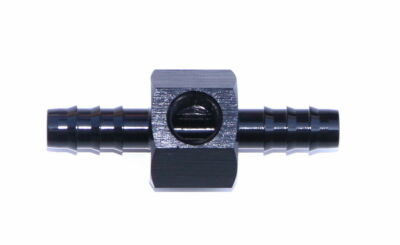
If you really wanted to you could put a 1/8npt gauge on of these and put it somewhere in the fuel ine:

Not sure why it would be leaking but my first guess would be bad hose. That doesn't look like fuel line and I see no clamp on there.
 
If you really wanted to you could put a 1/8npt gauge on of these and put it somewhere in the fuel ine:

Not sure why it would be leaking but my first guess would be bad hose. That doesn't look like fuel line and I see no clamp on there.
No, that is not the hose for the fuel line. That is the hose that comes with a mightyvac for checking vacuum. The hose that was connected is black and you can see it is unconnected in one of the pictures. The clamps are those old clip style clamps and you can see it in a picture. It could be that the clip is bad being that it is old and rusted and it probably is. I'm going to replace it with one that tightens with a screw. I just suspected this as being the issue (bad fuel pressure) as it would explain how this car runs.

I have a fuel pressure kit, but can't see how it can easily connect. From what I believe (unless I'm mistaken), you have to connect it on the supply side only. If you connect it on the return side, you will only be testing the pressure on the other side of the regulator. Total fuel pump pressure coming from the fuel pump minus the fuel pressure that gets past the regulator equals the fuel pipe pressure.

I don't see an easy way to connect to the supply line given that it is a structured hose with connectors at both ends that connect the fuel filter to the fuel pipe. I don't think it's a good idea to cut this line and t-tap it.

The line feeding into the fuel pipe
 
I've reconnected everything with better clamps and it no longer leaks, but I still believe that the fuel pressure regulator has some issues; only because how the engine is behaving. I'd like to connect a fuel pressure gauge into the fuel pipe somehow, but I don't know the best way to do it. The stock hose that connects the fuel filter to the fuel pipe is a crimped hose as you can see in the pictures. Too bad Mitsubishi didn't include a fitting in the fuel pipe like almost every other vehicle.

You must be logged in to view this image or video.


You must be logged in to view this image or video.
 

Attachments

You must be registered for see attachments list
That oem banjo bolt on top of the fuel filter is the largest restrictor in your fuel setup. If you simply swap that out for the -6an feed line, your system would benefit from it.
 
That oem banjo bolt on top of the fuel filter is the largest restrictor in your fuel setup. If you simply swap that out for the -6an feed line, your system would benefit from it.
I believe you. Is there a kit I could buy or separate parts I could buy to do this at minimal cost? I don't want to spend hundreds of dollars on this as it is a daily driver and very hungry.
 
It doesn't seem likely that it's being caused by too much fuel in the return line. If I had to guess (again), it would be high pressure in the fuel tank due to bad gas cap or evap filter.
 
It doesn't seem likely that it's being caused by too much fuel in the return line. If I had to guess (again), it would be high pressure in the fuel tank due to bad gas cap or evap filter.
I never thought that was the cause. I thought too much pressure in the return line is a symptom of a failed fuel pressure regulator. A failed FPR is a likely candidate based on how the engine is performing. I'd like to test the pressure but I don't see an easy way of hooking up a fuel pressure gauge. I haven't seen any type of reasonably priced adapter that would bolt on allowing a fuel pressure gauge to connect to it.
 
There is a siphon valve on the fuel pump hanger. It uses the returned fuel to siphon the fuel from the drivers side of the tank to the passenger side where the fuel pump is. If the small hole that the returned fuel is flowing through gets clogged the result is high return line pressure. As well as hi fuel pressure. Could be your problem.
 
There is a siphon valve on the fuel pump hanger.
Do you have any information on this siphon valve? Is there a page from a service manual that describes this?
It uses the returned fuel to siphon the fuel from the drivers side of the tank to the passenger side where the fuel pump is.
I didn't know there were two separate sides to the tank. I thought it was one big tank. Why would there be two sides; what's the purpose?
If the small hole that the returned fuel is flowing through gets clogged the result is high return line pressure. As well as hi fuel pressure. Could be your problem.
Is this small hole that you refer to the opening at the bottom of the fixture where the return line connects? Do you have any pictures to share?
 
Here is a picture the siphon valve. Ya GSX has a saddle style fuel tank to accommodate the drive shaft. For more info on the siphon valve search “siphon mod” on here. When running larger fuel pumps this mod may be required to control fuel pressure.

You must be logged in to view this image or video.
 

Attachments

You must be registered for see attachments list
Here is a picture the siphon valve. Ya GSX has a saddle style fuel tank to accommodate the drive shaft. For more info on the siphon valve search “siphon mod” on here. When running larger fuel pumps this mod may be required to control fuel pressure.

You must be logged in to view this image or video.
So that light brown plastic piece is supposed to be this siphon valve? How does it siphon from the driver side of the tank given that it's on the passenger side, an inch away from the fuel pump inlet? Is there supposed to be a hose that connects to the end of it where the other end is in the driver side of the tank?
 
Last edited:
Add Value - Be Respectful - No Trolling - No Misinformation - Participate Often!
Support Vendors who Support the DSM Community

Build Thread Updates

Latest Classifieds

Back
Top











