The Central Hub for DSM Community and Information

For 1990-1999 Mitsubishi Eclipse, Eagle Talon, Plymouth Laser, and Galant VR-4 Owners. This is where the DSM platform history is documented and archived. Log in to help us in our mission, and to remove most ads from the browsing experience.

Too Much Crank Case Pressure???

This site may earn a commission from merchant affiliate links, including eBay, Amazon, and others.

'96 GS-T MT

Probationary Member
11
0
Nov 6, 2009
New Castle, Colorado
Hello all!!! I need help. I am a new proud owner of a 96 GS-T. I recently got the car with the engine nearly dissasembled. I rebuilt the head and reassembled the engine. But now I am having a problem. Under high boost levels (factory) I am noticing the dipstick lifts from the tube and allows engine oil to "spit" from the tube and of course it starts to smoke. My question is, what could be causing this? I have checked the PCV valve and it functions correctly. I performed a leak down test and it passes. After speaking to the previous owner, this was not an issue before. So, what did I install incorrectly? What else shoud I check? Any takers? :banghead:
 
Yeah, its known to happen. What I did was used a piece of sloid copper electrical wiring,a nd bent it in a U shape. Then used a small hose clamp to clamp it so its snug. No problems like this.
 
I will try somthing like that to keep it down but does anyone know what the cause is? I understand that it is crank case pressure but should there be that much pressure?
 
a quote from "The Site" vfaq...

Dipstick popping out - happens due to crankcase pressure pushing the dipstick up:
A good running motor will blow out a dip stick with a shriveled hard rubber seal
A dead motor (lots of blow by, busted pistons) will blow out a good dipstick
A 1/2 dead motor will blow out a 1/2 dead dip stick
Depending on the actual cause and the severity, the fixes can be:
A spring/wire to hold the dipstick down
Pinch the tube at the top a bit
Get a new dipstick
A full engine rebuild or new pistons
If it blows out under boost with a glowing red turbo and manifold, it makes a nice engine fire. If it happens even once, figure out the cause and fix it
 
A new OEM dip stick is about 10 to 12 dollars with an O ring seal that fits tight.
Google for MD2865.

I replaced mine yesterday after it popped out under boost. The finger ring was already JB welded back on so the dip stick didn't know whether to drop down or pop out.
 
Last edited by a moderator:
Do a compression test, if it turns out fine then your oil seals in your turbo are bad. You could also do a boost leak test from the throttle body elbow and if it blows it out then you know it's air escaping past your rings.

I have done a compression test already. Actually before this problem occured. The test resulted in a pass. Actually, a very high pass. The oil seals in the turbo are also good. After further inspection, the O rings on the dipstick arent in the best condition so I am replacing them tomorrow. Thank you all for the imput and helping me get this figured out. You all are awsome!!!!:hellyeah:

a quote from "The Site" vfaq...

Dipstick popping out - happens due to crankcase pressure pushing the dipstick up:
A good running motor will blow out a dip stick with a shriveled hard rubber seal
A dead motor (lots of blow by, busted pistons) will blow out a good dipstick
A 1/2 dead motor will blow out a 1/2 dead dip stick
Depending on the actual cause and the severity, the fixes can be:
A spring/wire to hold the dipstick down
Pinch the tube at the top a bit
Get a new dipstick
A full engine rebuild or new pistons
If it blows out under boost with a glowing red turbo and manifold, it makes a nice engine fire. If it happens even once, figure out the cause and fix it

thank you. I did a search and no results where found. I am kinda new to this site so I didnt know where to look. Thank you for helping me out.
 
Last edited:
Do a compression test, if it turns out fine then your oil seals in your turbo are bad. You could also do a boost leak test from the throttle body elbow and if it blows it out then you know it's air escaping past your rings.

Wait, sorry I'm confused here, I don't know a huge amount about DSM and you seem too, how does the dipstick shooting have to do with a compression test? I read just some of this article before but noone super explained, I know the crankcase draws ALOT of pressure during boost, but doesn't it always do this, even if there are no leaks? I would imagine so, so wouldn't a leak cause there to be less pressure? I'm sorry if I look stupid asking, I'm just super confused right now, could you sort this out for me?
 
Wait, sorry I'm confused here, I don't know a huge amount about DSM and you seem too, how does the dipstick shooting have to do with a compression test? I read just some of this article before but noone super explained, I know the crankcase draws ALOT of pressure during boost, but doesn't it always do this, even if there are no leaks? I would imagine so, so wouldn't a leak cause there to be less pressure? I'm sorry if I look stupid asking, I'm just super confused right now, could you sort this out for me?

The point of the compression test is too see how healthy the motor is. If the rings are not sealing properly and causing excess blow by, the crankcase is being over pressurized. That is what the compression test has to do with the dipstick popping out.
 
Crimping the tube, a spring, and more o-rings is not an acceptable answer. A bad pcv, piston rings, even valve stem seals can be the culprit. My dipstick takes a minimum effort to remove, like about as much force as lifting the dipstick itself. I run 30 psi of boost daily, and i mean i beat on the car. My dipstick never pops out. I also did a complete rebuild and proper break in 5,000 miles ago. I bought a galant vr4 and it would pop out the dipstick at stock levels. A rebuild later it was running 38 psi with a holset hx40, with no problems.
Every crankcase pressure problem doesn't require a full rebuild. But, if that is what it takes to prevent your car from becoming a fireball, it's worth it.
 
The point of the compression test is too see how healthy the motor is. If the rings are not sealing properly and causing excess blow by, the crankcase is being over pressurized. That is what the compression test has to do with the dipstick popping out.

Okay I get what your saying for the most part, so normally under boosting conditions the crankcase will be under extreme pressure but not enough to say pop the stick, but if a ring is fried it would increase pressure causing the dipstick to possibly launch?
 
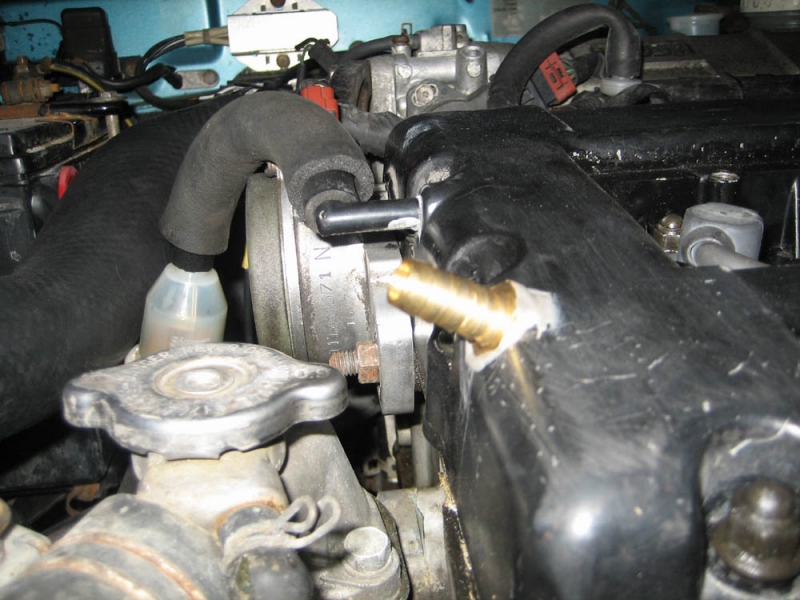
http://www.dsmtuners.com/forums/newbie-forum/229338-stupid-pcv-question.html This is where I got the idea to use one of these. Check Valves | U.S. Plastic Corp.

I haven't had excessive crankcase pressure issues since then.

The stock PCV valve barely holds back 10psi and you can still actually blow thru it with your mouth a little. Keep it in the VC b/c it acts as a metering device and also has a tube that goes into the baffle so you don't suck up oil.

Bingo.:thumb:


OP, I'm not sure how you tested the PCV valve but best way is to unscrew it from the valve cover but leave the other end hooked up to the vacuum line that connects it the intake manifold. Repeat the boost leak test and check for air leaking through it. This is usually and eye opening result. You can generate enough psi by blowing through it to test it properly.

This is the specific size of the check valve that you want:

3/8" Kynar® Liquid/Gas Check Valves | U.S. Plastic Corp.

Place it inline between PCV and IM with airflow direction (check valve has an arrow on it) towards the IM.
 
...so normally under boosting conditions the crankcase will be under extreme pressure but not enough to say pop the stick

Under normal conditions, the crankcase is not under "extreme" pressure even when in boost. Cylinder pressure should stay in the cylinders where it belongs, but some is invariably going to leak past the rings (assuming you aren't leaking intake pressure into the CC through a worn PCV valve or something in the first place). The higher the pressure in the cylinder, or the more worn the rings are...the more pressure can make it into the crankcase.

On my 2.3L stroker, I see about -1 inHg of vacuum in the crankcase at idle/cruise...

You must be logged in to view this image or video.


and about .6 psi in the crankcase at 20 psi of boost.

You must be logged in to view this image or video.


Excessive crankcase pressure is usually due to

1. poor crankcase ventilation and pressure relief (i.e. a hacked up or removed PCV system)
2. a leaking PCV valve (even new OEM ones can leak; Romeen posted the fix for this ^^^ ;))
3. worn rings/cylinders
4. loosely toleranced motors (larger ring gaps and some aftermarket pistons for example)
5. really high levels of boost
6. some combination of the above.

Whether or not your dipstick pops out simply depends on how much crankcase pressure you are building and how much the dipstick can hold back...either reduce the pressure (best), or tighten up the dipstick. :)
 

Attachments

You must be registered for see attachments list
Last edited by a moderator:
ahh okay I get what your saying now, thanks a bunch for clearing that up, you guys are a huge help on these forums and super friends, appreciate this.
 
Add Value - Be Respectful - No Trolling - No Misinformation - Participate Often!
Support Vendors who Support the DSM Community

Build Thread Updates

Latest Classifieds

Back
Top